Essential Direction & Travel Vocabulary
Before reading the story, review these important German words related to navigation and travel to help you understand the text better.
| German Word | English Translation |
|---|---|
| erkunden | to explore |
| die Kreuzung | intersection / crossroads |
| abbiegen | to turn |
| der Fahrkartenautomat | ticket machine |
| sich verlaufen | to get lost |
| die Wegbeschreibung | directions / route description |
| die Besichtigung | sightseeing / visit |
Story: Tims Erkundung in Berlin
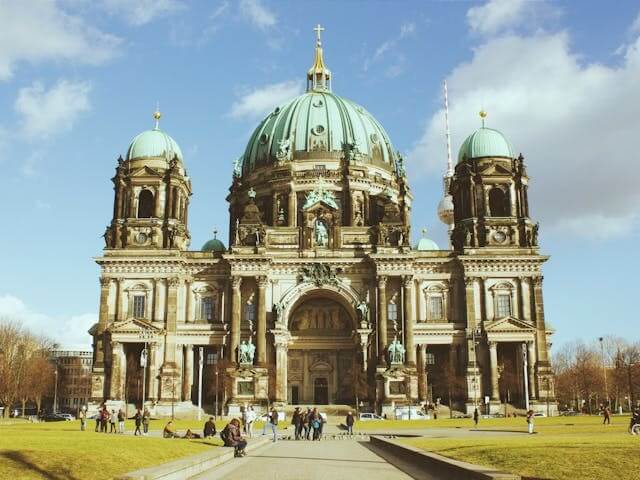
Tim ist zum ersten Mal in Berlin und hat beschlossen, die große Stadt zu Fuß zu erkunden. Er startet am Alexanderplatz, einem bekannten Platz im Zentrum. Dort sieht er viele Menschen und hört verschiedene Sprachen. Sein heutiges Ziel ist es, den berühmten Berliner Dom zu besuchen.
Zuerst geht er einfach geradeaus die Straße entlang. Nach ein paar Minuten erreicht er eine Kreuzung. Er entscheidet sich, nach links abzubiegen. Auf der rechten Seite sieht er einen Fahrkartenautomaten, aber er möchte lieber laufen, anstatt den Bus zu nehmen. Als er weitergeht, geht er über eine Brücke und macht ein paar schöne Fotos.
Plötzlich bemerkt Tim, dass er sich verlaufen hat. Er fragt eine nette Passantin: „Entschuldigung, wo ist der Berliner Dom?“ Die Frau lächelt und sagt: „Gehen Sie die nächste Straße rechts und dann immer geradeaus.“ Dankbar folgt Tim ihrer Wegbeschreibung.
Nach einem kurzen Spaziergang sieht Tim den imposanten Berliner Dom vor sich. Er atmet erleichtert auf und freut sich auf die Besichtigung.
Reading Comprehension Quiz
Test your understanding of the story by answering the questions below. Click on the drop-down menu to reveal the correct answer.
1. Wo startet Tim seinen Spaziergang in Berlin?
Correct Answer: Am Alexanderplatz. (At Alexanderplatz.)
2. Welches Verkehrsmittel möchte Tim nicht nehmen?
Correct Answer: Den Bus. (The bus.)
3. Was passiert Tim, nachdem er über die Brücke geht?
Correct Answer: Er verläuft sich. (He gets lost.)
4. Wie lautet die Wegbeschreibung der Passantin?
Correct Answer: Die nächste Straße rechts und dann immer geradeaus. (The next street right and then straight ahead.)
5. Welches Gebäude möchte Tim am Ende besichtigen?
Correct Answer: Den Berliner Dom. (The Berlin Cathedral.)
🚀 Continue Learning / Boost Your German
- Master German Nouns & Genders: German Premium Article Trainer
- Expand your vocabulary: German Vocabulary Blog Articles
- Test your knowledge: Grammar Quizzes
Frequently Asked Questions
How do you ask for directions in German?
As Tim demonstrates in the story, the simplest and most polite way to ask for directions is by saying: “Entschuldigung, wo ist [Location]?” (Excuse me, where is [Location]?). You can practice this and many other navigation phrases in our full guide on German travel and direction vocabulary.
What does “geradeaus” mean, and how is it used with “rechts” and “links”?
In the text, the woman tells Tim to go “rechts und dann immer geradeaus.” Geradeaus means “straight ahead.” It is usually combined with direction words like rechts (right) and links (left) to form complete directions. If you want to test your understanding of these words, try our free direction vocabulary quiz.
How does the verb “sich verlaufen” work?
The phrase “er hat sich verlaufen” means “he got lost” (while walking). It is a reflexive verb, meaning it requires the reflexive pronoun sich. If you are lost, you would say: “Ich habe mich verlaufen.” For more practice with this type of vocabulary at a beginner level, check out this beginner short story about travel.