
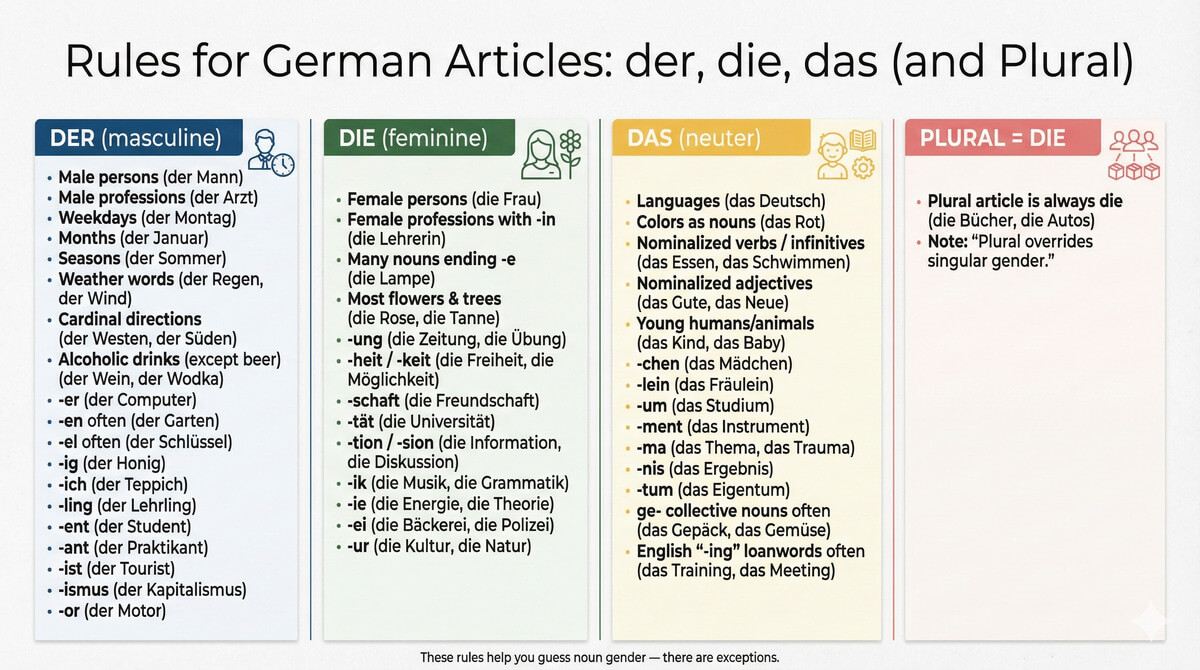
German article rules help you predict whether a noun takes der (masculine), die (feminine), or das (neuter). The most reliable patterns are noun endings: -ung, -heit, -keit, -schaft = always die. -chen, -lein, -um, -ment = always das. -ling, -ismus, -or, -ig = always der. Categories also help: days, months, and seasons are der; most flowers and trees are die; and the plural article is always die, regardless of gender. No rule covers every noun — but these patterns get you right about 75% of the time. Below you’ll find all the rules with examples, exceptions, and a quiz to test yourself.You already know what German articles are — der, die, das. You know that every noun has a gender. But how do you know which gender a noun has? That’s what this guide is about: the patterns and endings that help you predict the correct article without memorizing every single word. This page focuses purely on the gender rules. For how articles change across cases, see the Articles Chart. For the difference between “the” and “a/an” in German, read Definite vs. Indefinite Articles.
| If you want to know… | Read this |
|---|---|
| Which gender does a noun have? (Rules & patterns) | You’re here |
| What are articles & how do they work? | Articles Overview |
| How do articles change across cases? | Articles Chart |
| Learn “der/die/das” vs. “ein/eine” | Definite vs. Indefinite |
| How do definite articles work in all cases? | Definite Articles |
| How do indefinite articles work? | Indefinite Articles |
DER — Masculine Noun Rules
Masculine nouns fall into two groups: categories (where the meaning determines the gender) and endings (where the suffix determines the gender).Masculine by Category
- Male persons: der Mann, der Vater, der Bruder, der Arzt — 100% reliable
- Male professions: der Lehrer, der Koch, der Pilot (female versions get -in and become die: die Lehrerin) — 100% reliable
- Days of the week: der Montag, der Dienstag, der Mittwoch… — 100% reliable
- Months: der Januar, der Februar, der März… — 100% reliable
- Seasons: der Frühling, der Sommer, der Herbst, der Winter — 100% reliable
- Weather words: der Regen, der Schnee, der Wind, der Nebel, der Sturm
- Cardinal directions: der Norden, der Süden, der Osten, der Westen — 100% reliable
- Alcoholic drinks (except beer): der Wein, der Wodka, der Whisky (but: das Bier)
Masculine by Ending
- -er (very common): der Computer, der Drucker, der Koffer — but some exceptions: die Butter, die Mutter, das Fenster
- -en (often): der Garten, der Boden, der Wagen
- -el (often): der Schlüssel, der Mantel, der Löffel
- -ig: der Honig, der Essig, der König
- -ich: der Teppich, der Bereich, der Rettich
- -ling: der Lehrling, der Schmetterling, der Frühling — 100% reliable, no exceptions
- -ent: der Student, der Patient, der Präsident (these also follow N-Deklination)
- -ant: der Praktikant, der Musikant, der Elefant (also N-Deklination)
- -ist: der Tourist, der Polizist, der Optimist (also N-Deklination)
- -or: der Motor, der Autor, der Doktor
- -ismus: der Tourismus, der Kapitalismus, der Optimismus — 100% reliable, no exceptions
DIE — Feminine Noun Rules
Feminine has the most reliable suffix rules — it can make sense to learn these first.Feminine by Category
- Female persons: die Frau, die Mutter, die Schwester, die Tante — 100% reliable
- Female professions (-in): die Lehrerin, die Ärztin, die Köchin — 100% reliable
- Most flowers: die Rose, die Tulpe, die Lilie
- Most trees: die Eiche, die Tanne, die Birke
Feminine by Ending
- -ung: die Übung, die Zeitung, die Wohnung — 100% reliable
- -heit: die Freiheit, die Gesundheit, die Schönheit — 100% reliable
- -keit: die Möglichkeit, die Freundlichkeit — 100% reliable
- -schaft: die Freundschaft, die Wirtschaft, die Wissenschaft — 100% reliable
- -tät: die Universität, die Qualität, die Realität — 100% reliable
- -tion / -sion: die Information, die Diskussion, die Situation — 100% reliable
- -ik: die Musik, die Grammatik, die Politik
- -ie: die Energie, die Theorie, die Demokratie
- -ei: die Bäckerei, die Polizei, die Türkei
- -ur: die Kultur, die Natur, die Frisur
- -e (many, not all): die Lampe, die Straße, die Sonne — but some exceptions: der Name, der Junge, das Ende
DAS — Neuter Noun Rules
Neuter has fewer categories but some very reliable endings.Neuter by Category
- Languages: das Deutsch, das Englisch, das Französisch — 100% reliable
- Colors as nouns: das Rot, das Blau, das Grün — 100% reliable
- Nominalized verbs (infinitives): das Essen, das Schwimmen, das Lesen — 100% reliable
- Nominalized adjectives: das Gute, das Neue, das Schöne — 100% reliable
- Young humans and animals: das Kind, das Baby, das Lamm, das Kalb
Neuter by Ending
- -chen: das Mädchen, das Brötchen, das Hähnchen — 100% reliable (diminutive)
- -lein: das Fräulein, das Büchlein — 100% reliable (diminutive)
- -um: das Studium, das Zentrum, das Museum — 100% reliable
- -ment: das Instrument, das Experiment, das Dokument
- -ma: das Thema, das Trauma, das Drama
- -nis: das Ergebnis, das Erlebnis, das Geheimnis (but: die Kenntnis, die Erlaubnis)
- -tum: das Eigentum, das Wachstum (but: der Reichtum, der Irrtum)
- Ge- prefix (collective nouns, often): das Gepäck, das Gemüse, das Geschenk, das Gebäude — but some exceptions: der Geschmack, die Geschichte
- English “-ing” loanwords (often): das Training, das Meeting, das Camping
Plural = Always DIE
Regardless of whether a noun is masculine, feminine, or neuter in the singular, the plural article is always die:- der Tisch (the table) → die Tische (the tables)
- die Lampe (the lamp) → die Lampen (the lamps)
- das Buch (the book) → die Bücher (the books)
Exceptions to Watch Out For
Not every rule works 100% of the time. Here are the most common traps:| You’d expect… | But it’s actually… | Why |
|---|---|---|
| die Mädchen (it’s a girl) | das Mädchen | -chen = always neuter, overrides natural gender |
| der Butter (-er ending) | die Butter | -er is only a tendency, not a guaranteed rule |
| der Fenster (-er ending) | das Fenster | Same — -er has some exceptions |
| die Name (-e ending) | der Name | -e is only a tendency, some masculine exceptions |
| das Reichtum (-tum = das?) | der Reichtum | -tum is mostly neuter but has a few der-exceptions |
| der Bier (alcoholic drink = der?) | das Bier | Beer is the famous exception to the alcohol rule |
Common Mistakes to Avoid
❌ Wrong: Die Mädchen ist nett.
✅ Correct: Das Mädchen ist nett.
💡 Why: -chen = always das. The diminutive suffix overrides natural gender. Same for das Brötchen, das Hähnchen.
❌ Wrong: der Universität
✅ Correct: die Universität
💡 Why: -tät = always die. This is one of the “golden six” suffixes that are 100% feminine.
❌ Wrong: das Computer
✅ Correct: der Computer
💡 Why: -er ending = usually masculine. Computer, Drucker, Becher — most -er nouns are der.
❌ Wrong: Learning “Tisch = the table” without an article.
✅ Correct: Learning “der Tisch = the table” from day one.
💡 Why: If you learn nouns without articles, you’ll have to guess every time you speak. Always learn noun + article + plural as one unit: der Tisch, die Tische.
❌ Wrong: Assuming grammatical gender = natural gender.
✅ Correct: Treating gender as a grammatical category.
💡 Why: Das Mädchen (girl) is neuter. Der Tisch (table) is masculine. German gender has little to do with biological sex — it’s a classification system that affects cases, adjective endings, and pronouns.
Test Yourself: 5 Quick Questions
Apply the rules you just learned. Which article does each noun take?1. ___ Freiheit
- A) der
- B) die
- C) das
Check Answer
2. ___ Mädchen
- A) der
- B) die
- C) das
Check Answer
3. ___ Montag
- A) der
- B) die
- C) das
Check Answer
4. ___ Studium
- A) der
- B) die
- C) das
Check Answer
5. ___ Freundschaft
- A) der
- B) die
- C) das
Check Answer
Reading the rules helps. Practicing them daily is what makes der, die, das automatic.
The Article Trainer drills 1,000+ German nouns organized by the exact rules on this page. Pick your level (A1–C1), see a word, choose the article — and every time you slip, the rule behind it appears instantly. Struggling words come back through built-in spaced repetition until the patterns stick.
Built by the native German tutor Niko with 5,000+ lessons taught · Lifetime access · 14-day money-back guarantee
Practice German Articles — $65 →Frequently Asked Questions
How many genders are there in German?
Three: masculine (der), feminine (die), and neuter (das). Every German noun has one of these genders, and you need to learn it along with the noun. In addition, all plural nouns use the article die regardless of their singular gender.What are the most reliable rules for der (masculine)?
Male persons and male professions are always masculine (der Mann, der Lehrer). The most reliable endings are -ling (der Schmetterling) and -ismus (der Tourismus) — both have zero exceptions. Categories like days of the week, months, seasons, and weather words are also reliable. Less reliable are -er, -en, -el, which have some exceptions.What are the most reliable rules for die (feminine)?
Female persons and female professions are always feminine (die Frau, die Lehrerin). The six suffixes -ung, -heit, -keit, -schaft, -tät, -tion are all 100% feminine with no exceptions. If a noun ends in any of these, it’s always die.What are the most reliable rules for das (neuter)?
The diminutive suffixes -chen and -lein always make a noun neuter — even das Mädchen (girl). The ending -um (das Studium, das Museum) is also highly reliable. Nominalized verbs (das Essen, das Lesen), nominalized adjectives (das Gute, das Neue), languages (das Deutsch), and colors as nouns (das Rot) are always neuter.Are there exceptions to the German article rules?
Yes. Rules based on suffixes (-ung, -chen, -ismus) have very few or no exceptions. Rules based on common endings like -er or -e are only tendencies with some exceptions (die Butter, der Name). The safest approach is to learn each noun with its article and use the rules as helpful shortcuts, not absolute laws.How can I memorize der, die, das effectively?
Start by memorizing the most reliable suffix rules (the “golden six” for feminine, -chen/-lein for neuter, -ling/-ismus for masculine). Then practice with real nouns — never learn a noun without its article. Tools like the Article Trainer group nouns by their gender rules, making the patterns stick through repetition.Do German articles change with cases?
Yes. The articles der, die, das are the nominative (subject) forms. In the accusative, der changes to den. In the dative, the forms change to dem/der/dem. In the genitive, they become des/der/des. For a complete overview, see Cases in German.What percentage of German nouns are feminine, masculine, or neuter?
According to the Duden, approximately 46% of German nouns are feminine (die), 34% are masculine (der), and 20% are neuter (das). This is why die is statistically the best guess if you have no idea — but learning the rules on this page gets you much further than guessing.Stop guessing der, die, das — for good.
You’ve seen the rules. The Article Trainer turns them into instinct: 1,000+ nouns filtered to your level, instant rule explanations on every mistake, an end-of-round summary of your weak patterns, and spaced repetition that targets exactly the words you struggle with. One payment, lifetime access — no subscription.
Built by the native German tutor Niko with 5,000+ lessons taught
Get the Article Trainer — $65 →