
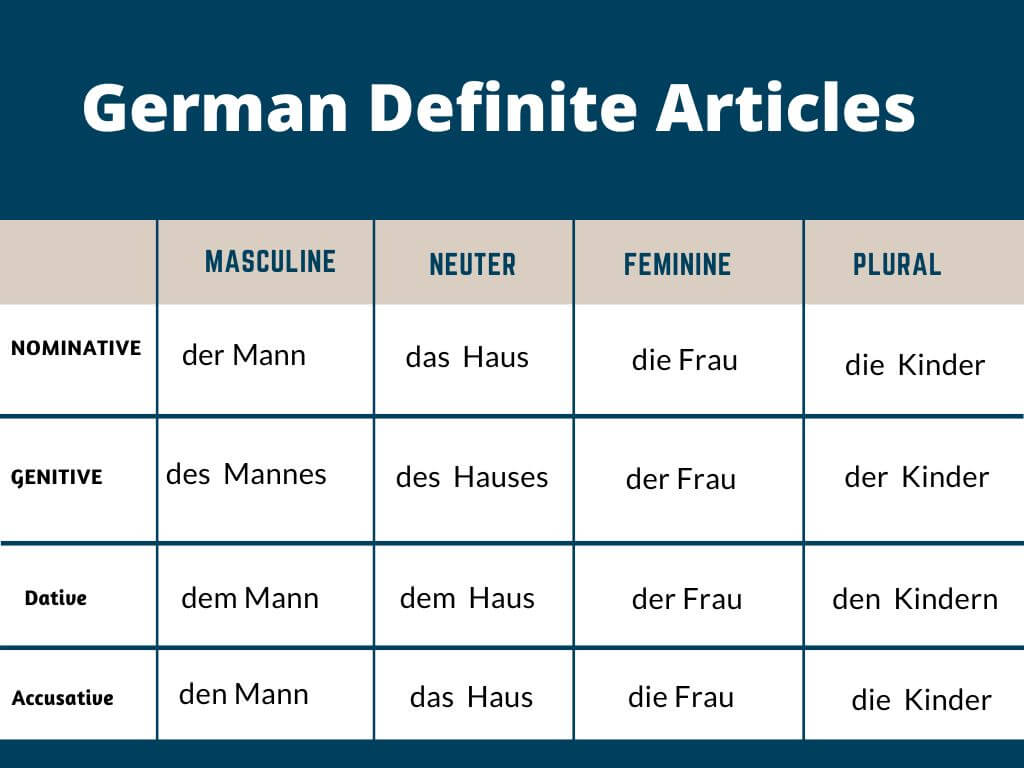
German Articles Chart: German has three definite articles — der (masculine), die (feminine), and das (neuter) — and two indefinite articles — ein (masculine/neuter) and eine (feminine). All articles change depending on the grammatical case (nominative, accusative, dative, genitive). The charts below show every form at a glance.The German article system is one of the first things you need to learn — and one of the things that causes the most confusion. The charts on this page give you a complete reference for every definite and indefinite article form across all four German cases. If you’re looking for the rules behind why a noun is der, die, or das, check out the German Article Rules page. This page focuses on the charts and how to read them.
German Definite Article Chart (Der, Die, Das)
The German definite articles are used when referring to a specific noun — like “the” in English. There are three genders plus plural:The 3 definite articles:
Der → masculine (der Mann = the man)
Die → feminine (die Frau = the woman) and plural (die Kinder = the children)
Das → neuter (das Haus = the house)
These base forms are the nominative case (the subject of a sentence). In the other cases, the articles change:
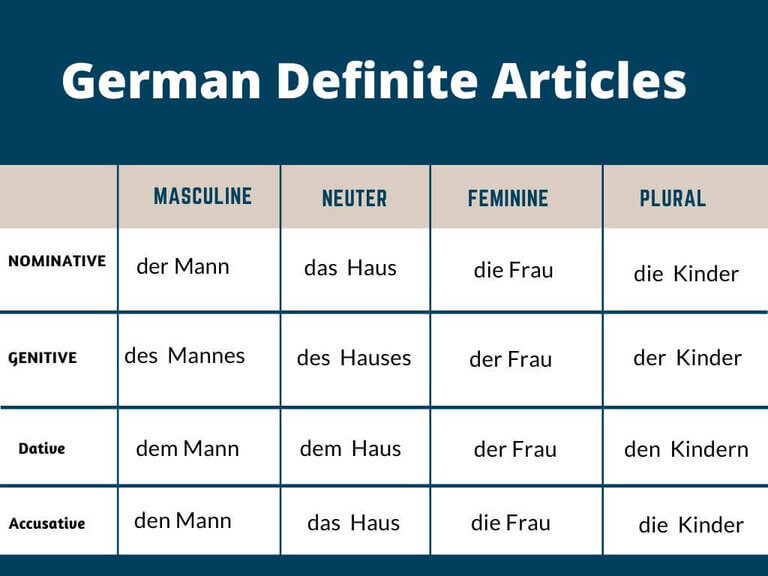
← swipe to see the full table →
| Case | Masculine | Neuter | Feminine | Plural |
|---|---|---|---|---|
| Nominative | der Mann | das Haus | die Frau | die Kinder |
| Genitive | des Mannes | des Hauses | der Frau | der Kinder |
| Dative | dem Mann | dem Haus | der Frau | den Kindern |
| Accusative | den Mann | das Haus | die Frau | die Kinder |
How to Read This Chart
Each row is a grammatical case (nominative, genitive, dative, accusative). Each column is a gender or plural. To find the right article, you need two things: the gender of the noun and the case it’s in. For example: “I give the man a book” → “the man” is dative (receiving something) + masculine → look at the dative row, masculine column → dem Mann. Not sure how the four cases work? Read the full explanation: Cases in German — Easily Explained.German Indefinite Article Chart (Ein, Eine)
The German indefinite articles work like “a/an” in English — they refer to an unspecified noun. The key difference from English: they also change with the grammatical case.The 2 indefinite articles:
Ein → masculine and neuter
Eine → feminine
No plural form — German has no indefinite plural article (like English: “I see dogs” not “I see a dogs”).
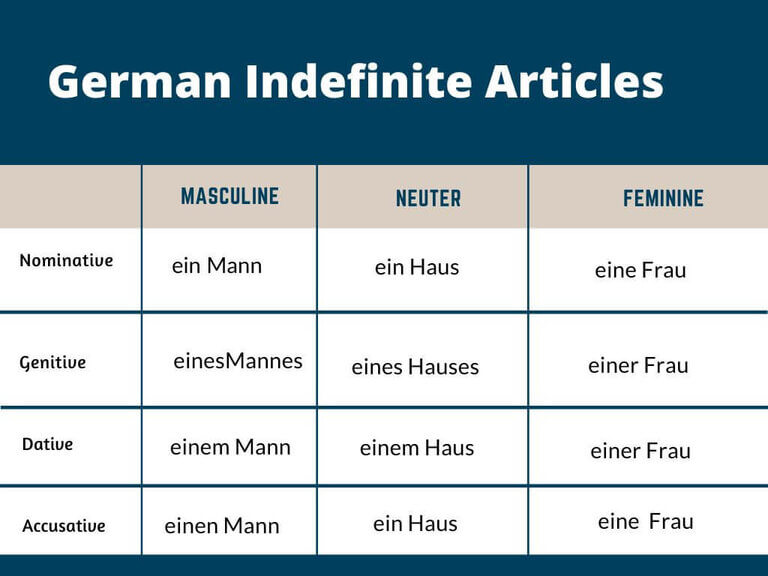
← swipe to see the full table →
| Case | Masculine | Neuter | Feminine | Plural |
|---|---|---|---|---|
| Nominative | ein Mann | ein Haus | eine Frau | — (no article) |
| Genitive | eines Mannes | eines Hauses | einer Frau | — (no article) |
| Dative | einem Mann | einem Haus | einer Frau | — (no article) |
| Accusative | einen Mann | ein Haus | eine Frau | — (no article) |
Patterns & Shortcuts to Memorize the Charts
You don’t need to memorize every cell individually. There are clear patterns that make it much easier:Pattern 1 — Feminine and plural are identical in nominative & accusative:
Nominative: die Frau / die Kinder
Accusative: die Frau / die Kinder
→ That’s 4 cells you already know.
Pattern 2 — Neuter nominative and accusative are always the same:
Nominative: das Haus → Accusative: das Haus
Nominative: ein Haus → Accusative: ein Haus
→ Neuter never changes between these two cases.
Pattern 3 — Only masculine changes in the accusative:
der → den / ein → einen
→ This is the only gender where nominative ≠ accusative.
Pattern 4 — Dative is consistent:
Masculine & neuter: dem / einem
Feminine: der / einer
Plural: den + -n on the noun (den Kindern)
→ Learn “dem, der, den” and you’ve got dative covered.
Pattern 5 — Genitive follows one simple rule:
Masculine & neuter: des / eines + noun often gets -(e)s (des Mannes, des Hauses)
Feminine & plural: der / einer
These patterns also apply to adjective endings, so learning them now saves you a lot of work later.
A chart shows you the forms — but you still have to know the gender to use it. Every cell above starts with one question: is the noun der, die, or das? The Article Trainer drills the gender of 1,000+ nouns until it’s automatic, shows you the rule behind every mistake, and brings weak words back through spaced repetition. Turn the chart into instinct →
Bonus: Negation Articles (Kein, Keine)
The negation article kein (“not a / no”) follows exactly the same pattern as ein/eine — but it also has a plural form (keine):Kein follows ein — with one addition:
Masculine nominative: kein Mann (no man)
Feminine nominative: keine Frau (no woman)
Plural nominative: keine Kinder (no children)
→ All case changes work like ein/eine. Just add “k” in front.
Test Yourself: 5 Quick Questions
1. “I see the man.” → Ich sehe ___ Mann.
A) der
B) den
C) dem
D) des
Check Answer
Correct Answer: B) den
“Sehen” takes the accusative case. Masculine accusative = den.
2. “I give the woman a book.” → Ich gebe ___ Frau ein Buch.
A) die
B) den
C) der
D) dem
Check Answer
Correct Answer: C) der
“Der Frau” is feminine dative (she receives the book). Feminine dative = der.
3. “The house is big.” → ___ Haus ist groß.
A) Der
B) Die
C) Das
D) Den
Check Answer
Correct Answer: C) Das
Haus is neuter. It’s the subject of the sentence = nominative. Neuter nominative = das.
4. “He has a cat.” → Er hat ___ Katze.
A) ein
B) eine
C) einen
D) einer
Check Answer
Correct Answer: B) eine
Katze is feminine. “Haben” takes the accusative. Feminine accusative indefinite = eine (same as nominative — feminine doesn’t change!).
5. “I help the children.” → Ich helfe ___ Kindern.
A) die
B) der
C) dem
D) den
Check Answer
Correct Answer: D) den
“Helfen” takes the dative case. Plural dative = den + the noun gets an -n ending (Kindern). Remember: dative plural always adds -n!
Still Guessing Der, Die, or Das? 🎯
A chart helps you understand the system — but to actually remember 1,000+ nouns with their articles, you need practice. The Article Trainer filters words to your level (A1–C1), gives you randomized rounds with instant feedback, shows the rule behind every mistake, and uses spaced repetition so the genders truly stick.
Built by the native German tutor Niko with 5,000+ lessons taught · Lifetime access · 14-day money-back guarantee
Get the Article Trainer — $65 →Common Mistakes with German Articles
⚠️ Mixing up “den” and “dem”: Both appear in the dative and accusative charts, which makes them easy to confuse. Den is accusative masculine (“Ich sehe den Mann”) and dative plural (“Ich helfe den Kindern”). Dem is dative masculine/neuter (“Ich helfe dem Mann”). If you’re not sure which case to use, check the German cases guide.
⚠️ Forgetting the -n in dative plural: In the dative case, the plural article is den AND the noun usually gets an extra -n: den Kindern, den Häusern. Many learners remember the article but forget the noun ending — or the other way around.
⚠️ Assuming “die” is always feminine: Die is feminine in the nominative and accusative — but it’s also the plural article in those same cases. So when you see die, it could be feminine singular or plural (any gender). Context and the noun tell you which one it is.
⚠️ Learning nouns without articles: If you learn “Tisch = table” without its article, you’ll never know it’s der Tisch. Always learn the noun together with its article from day one: der Tisch, die Lampe, das Buch. For the rules that help you predict the gender, see German Article Rules.