
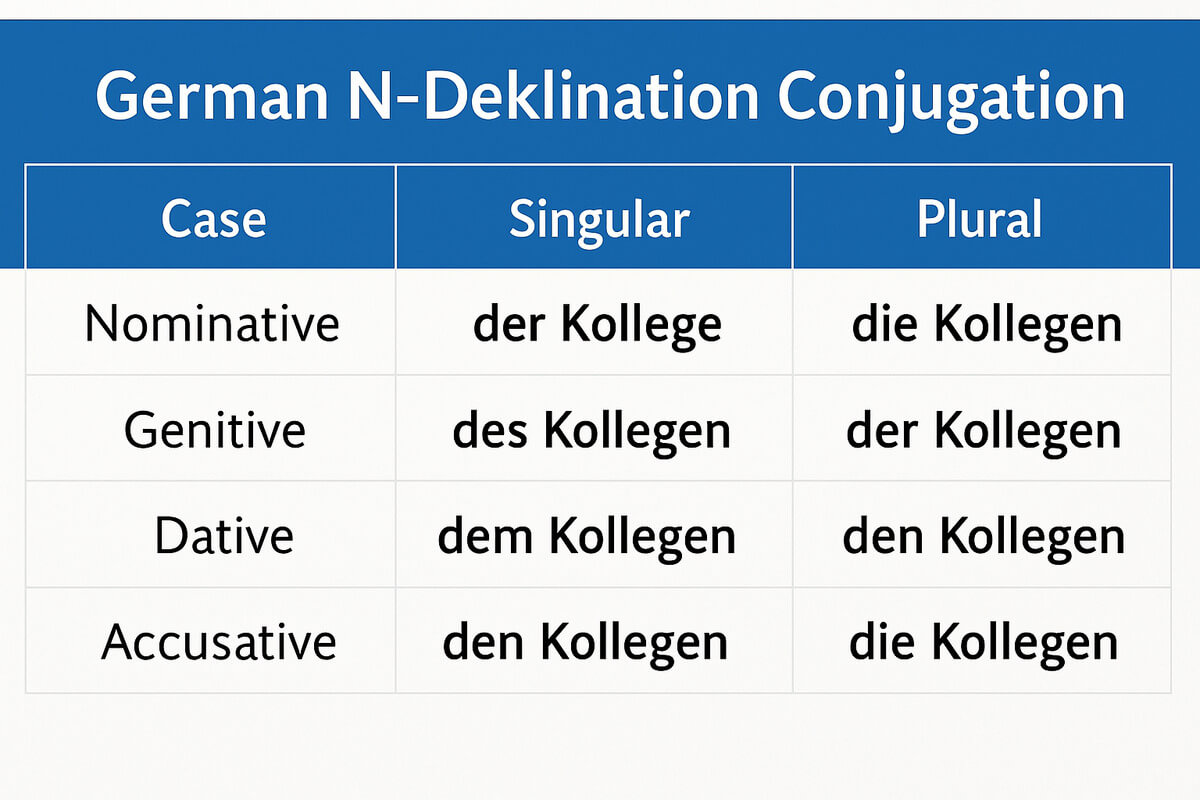
German N-Deklination (N-Declension): The N-Deklination — also called schwache Maskulina (weak masculine nouns) — is a German grammar rule where certain masculine nouns add -n or -en to the noun itself in every case except the nominative singular. It mainly affects masculine nouns ending in -e (e.g., der Junge → den Jungen) and nouns with Latin or Greek suffixes like -ist, -ent, -ant, -oge (e.g., der Student → den Studenten). However, forgetting the -n/-en ending is one of the most common grammar mistakes in German exams — and a few nouns like der Name follow a special sub-pattern that must be learned separately.Most masculine nouns in German don’t change form in the accusative or dative — only the article changes. But N-Deklination nouns are different: the noun itself adds -n or -en in every case except the nominative singular. If you’ve ever said or written “Ich sehe den Student” instead of “den Studenten,” this guide is for you. This article covers the complete rules, a full declension chart, individual noun tables for the most common examples, the der Name special case, the most common mistakes, and a quiz to test yourself. For the general overview of how German cases work, see the Cases guide first.
What is the N-Deklination?
In standard German declension, masculine nouns stay the same in the accusative and dative — only the article changes. Compare der Mann (a regular masculine noun) with der Junge (an N-Deklination noun):N-Deklination Chart
← swipe to see the full table →
| Case | Singular | Plural |
|---|---|---|
| Nominative | der Junge | die Jungen |
| Genitive | des Jungen | der Jungen |
| Dative | dem Jungen | den Jungen |
| Accusative | den Jungen | die Jungen |
Which Nouns Follow the N-Deklination?
N-Deklination only applies to masculine nouns. Here are the patterns to recognize them. If you are unsure about the gender of a noun, the German Article Rules guide explains the gender prediction patterns in detail.← swipe to see the full table →
| Pattern | Examples |
|---|---|
| Masculine nouns ending in -e (people, animals) | der Junge, der Kollege, der Kunde, der Löwe, der Affe, der Hase, der Neffe, der Rabe |
| Nouns ending in -and | der Proband, der Doktorand |
| Nouns ending in -ant | der Praktikant, der Elefant, der Demonstrant, der Kommandant |
| Nouns ending in -ent | der Student, der Patient, der Präsident, der Dozent, der Assistent |
| Nouns ending in -oge | der Biologe, der Psychologe, der Geologe, der Kardiologe |
| Nouns ending in -ad | der Kamerad |
| Nouns ending in -at | der Soldat, der Bürokrat, der Kandidat, der Akrobat |
| Nouns ending in -ist | der Journalist, der Tourist, der Pianist, der Florist, der Aktivist |
| Common exceptions (irregular) | der Herr, der Nachbar, der Bauer, der Bär, der Held, der Mensch, der Pilot, der Prinz, der Fotograf, der Architekt |
Declension Tables for Common N-Deklination Nouns
The most commonly searched N-Deklination nouns are shown below. The first table covers nouns that follow the regular pattern. The second shows der Nachbar separately — it is an irregular exception that adds only -n (not -en).Regular N-Deklination Pattern
← swipe to see the full table →
| Case | der Junge | der Kollege | der Student | der Patient |
|---|---|---|---|---|
| Nominative | der Junge | der Kollege | der Student | der Patient |
| Genitive | des Jungen | des Kollegen | des Studenten | des Patienten |
| Dative | dem Jungen | dem Kollegen | dem Studenten | dem Patienten |
| Accusative | den Jungen | den Kollegen | den Studenten | den Patienten |
| Plural (all cases) | Jungen | Kollegen | Studenten | Patienten |
Irregular Exception: der Nachbar
← swipe to see the full table →
| Case | Singular | Plural |
|---|---|---|
| Nominative | der Nachbar | die Nachbarn |
| Genitive | des Nachbarn | der Nachbarn |
| Dative | dem Nachbarn | den Nachbarn |
| Accusative | den Nachbarn | die Nachbarn |
Special Case: der Name (and similar nouns)
A small group of N-Deklination nouns follows a slightly different pattern in the genitive. The most important example is der Name. Instead of adding just -n, these nouns add -ns in the genitive singular:← swipe to see the full table →
| Case | Singular | Plural |
|---|---|---|
| Nominative | der Name | die Namen |
| Genitive | des Namens | der Namen |
| Dative | dem Namen | den Namen |
| Accusative | den Namen | die Namen |
Special Case: “Das Herz”
You may see “das Herz” listed under N-Deklination in textbooks. It is a Sonderform that is sometimes grouped with N-Deklination nouns — but it should be learned as a separate exception. It is neuter (not masculine), and its genitive adds -ens (not just -en):← swipe to see the full table →
| Case | Singular | Plural |
|---|---|---|
| Nominative | das Herz | die Herzen |
| Genitive | des Herzens | der Herzen |
| Dative | dem Herzen | den Herzen |
| Accusative | das Herz | die Herzen |
Example Sentences
Each example below shows the N-Deklination noun in a case other than nominative — where the -n/-en ending is required.← swipe to see the full table →
| Pattern | Example | Translation |
|---|---|---|
| -e (person) | Ich arbeite mit dem Kollegen. | I work with the colleague. |
| -e (animal) | Die Federn des Raben sind schwarz. | The raven’s feathers are black. |
| -e (animal) | Der Zoowärter füttert den Löwen. | The zookeeper feeds the lion. |
| -e (animal) | Das Kind beobachtet den Affen im Zoo. | The child watches the monkey at the zoo. |
| -ant | Der Forscher begleitet den Elefanten. | The researcher accompanies the elephant. |
| -ent | Der Arzt behandelt den Patienten. | The doctor treats the patient. |
| -ent | Die Arbeit des Studenten ist sehr gut. | The student’s work is very good. |
| -ist | Ich lese den Artikel des Journalisten. | I read the journalist’s article. |
| -at | Die Frau wartet auf den Soldaten. | The woman waits for the soldier. |
| -oge | Die Praxis des Psychologen ist sehr groß. | The psychologist’s office is very large. |
| Special: -ns genitive | Ich habe den Namen vergessen. | I forgot the name. |
| Exception | Ich helfe dem Nachbarn jeden Tag. | I help the neighbour every day. |
How to Remember the N-Deklination
Test Yourself: 5 Quick Questions
For each sentence, decide: does the noun need -n, -en, or nothing added?1. Ich sehe den Student___ in der Bibliothek.
- A) -n
- B) -en
- C) nothing
Check Answer
2. Die Junge___ spielen im Park.
- A) -n
- B) -en
- C) nothing
Check Answer
3. Die Arbeit des Präsident___ ist stressig.
- A) -s
- B) -es
- C) -en
Check Answer
4. Ich helfe dem Nachbar___ jeden Tag.
- A) -n
- B) -en
- C) nothing
Check Answer
5. Der Kollege___ kommt heute nicht ins Büro.
- A) -n
- B) -en
- C) nothing
Check Answer
Every N-Deklination Noun is Masculine. Do You Know Your Articles?
N-Deklination only affects masculine nouns — but do you actually know which nouns are masculine? Is it der Patient or das Patient? Is it der Kunde or die Kunde? Every N-Deklination rule starts with knowing the gender. The Article Trainer drills 1,000+ essential nouns filtered to your level (A1–C1), shows you the rule behind every mistake, and uses spaced repetition so the genders truly stick.
Built by the native German tutor Niko with 5,000+ lessons taught · Lifetime access · 14-day money-back guarantee
Get the Article Trainer — $65 →Common Mistakes to Avoid
❌ Wrong: Ich sehe den Student.
✅ Correct: Ich sehe den Studenten.
💡 Why: “Student” is an N-Deklination noun (suffix -ent). In the accusative, it must add -en. Forgetting the ending is the #1 N-Deklination mistake.
❌ Wrong: Die Arbeit des Studentes ist gut.
✅ Correct: Die Arbeit des Studenten ist gut.
💡 Why: Normal masculine nouns add -(e)s in the genitive (des Mannes). But N-Deklination nouns add -en instead — never -(e)s. “Des Studentes” does not exist.
❌ Wrong: Sie hilft dem Patient.
✅ Correct: Sie hilft dem Patienten.
💡 Why: “Helfen” takes the dative. “Patient” is N-Deklination (-ent) → dative = dem Patienten. The -en ending is required in every case except nominative singular.
❌ Wrong: Die Student sind in der Bibliothek.
✅ Correct: Die Studenten sind in der Bibliothek.
💡 Why: N-Deklination nouns need -n/-en in ALL plural forms — including nominative plural. “Die Student” does not exist. It is always “die Studenten.”
❌ Wrong: Das ist der Name des Namen.
✅ Correct: Das ist der Name des Namens.
💡 Why: “Der Name” belongs to the -ns genitive subgroup. In the genitive, it adds -ns — not just -n like regular N-Deklination nouns. “Des Namen” does not exist — the correct genitive is always “des Namens.”
Frequently Asked Questions
What is the N-Deklination in German?
The N-Deklination — also called schwache Maskulina (weak masculine nouns) — is a declension pattern where certain masculine nouns add -n or -en to the noun itself in the accusative, dative, and genitive cases, and in all plural forms. Only the nominative singular stays unchanged. It mainly affects masculine nouns ending in -e, and nouns with Latin/Greek suffixes like -ist, -ent, -ant, -oge, -at.What is the difference between N-Deklination and normal declension?
In normal declension, masculine nouns don’t change in the accusative or dative — only the article changes (der Mann → den Mann → dem Mann). In N-Deklination, the noun itself changes too: der Student → den Studenten → dem Studenten. Normal masculine nouns also add -(e)s in the genitive (des Mannes), while N-Deklination nouns add -en (des Studenten).Which endings indicate an N-Deklination noun?
The most common endings are: -e (der Junge, der Kollege, der Löwe), -ist (der Tourist, der Journalist), -ent (der Student, der Patient), -ant (der Praktikant, der Elefant), -oge (der Biologe, der Psychologe), -at (der Soldat, der Kandidat), -ad (der Kamerad), and -and (der Doktorand). These are almost always professions, nationalities, or academic titles.Where can I find a complete list of N-Deklination nouns?
The tables in this article cover the most common patterns and examples. For noun genders — which determine which nouns are even eligible for N-Deklination — use the German Article Rules guide. For further practice, try the N-Deklination Quiz.Do N-Deklination nouns add -(e)s in the genitive?
No. This is one of the most common mistakes. Normal masculine nouns add -(e)s in the genitive: “des Mannes.” But N-Deklination nouns add -en instead: “des Studenten” — never “des Studentes.” The one exception is the -ns genitive subgroup (des Namens, des Gedankens), which adds -ns instead of just -en.What is the -ns genitive in N-Deklination?
A small subgroup of N-Deklination nouns — including der Name, der Gedanke, der Glaube, der Wille — add -ns in the genitive singular instead of just -n. So: des Namens, des Gedankens. In all other cases (accusative, dative, plural) they follow the regular N-Deklination pattern: den Namen, dem Namen, die Namen.Does N-Deklination affect adjective endings?
No — N-Deklination changes the noun, not the adjective. Adjective endings follow their own rules based on the article type — see the German Adjective Endings guide. So “den jungen Studenten” has a normal adjective ending (-en after definite article in accusative) plus the N-Deklination noun ending (-en on Studenten). They happen independently.Is “der Herr” an N-Deklination noun?
Yes, but it is slightly irregular. In the singular, “Herr” adds only -n (den Herrn, dem Herrn, des Herrn). In the plural, it adds -en (die Herren). Other irregular N-Deklination nouns like “der Nachbar” and der Bär add -n in all non-nominative forms: den Nachbarn, dem Nachbarn, des Nachbarn.Is “das Herz” an N-Deklination noun?
Not exactly. “Das Herz” is sometimes listed under N-Deklination in textbooks, but it is better learned as a separate irregular noun. It is neuter (not masculine), its genitive is “des Herzens” (not “des Herzen”), and the accusative singular does not change. Learn it as a one-off exception.What is the difference between N-Deklination and weak nouns in German?
Schwache Maskulina (weak masculine nouns) and N-Deklination nouns are the same thing — just two different names for the same grammar rule. German grammar textbooks often use schwache Maskulina, while many online resources use N-Deklination. Both refer to masculine nouns that add -n or -en in all cases except nominative singular.It all starts with der, die, das.
N-Deklination, cases, adjective endings — every rule builds on one thing: knowing a noun’s gender. The Article Trainer turns gender into instinct: 1,000+ nouns filtered to your level, an instant rule explanation on every mistake, an end-of-round summary of your weak patterns, and spaced repetition that targets exactly the words you struggle with. One payment, lifetime access — no subscription.
Built by the native German tutor Niko with 5,000+ lessons taught
Get the Article Trainer — $65 →