
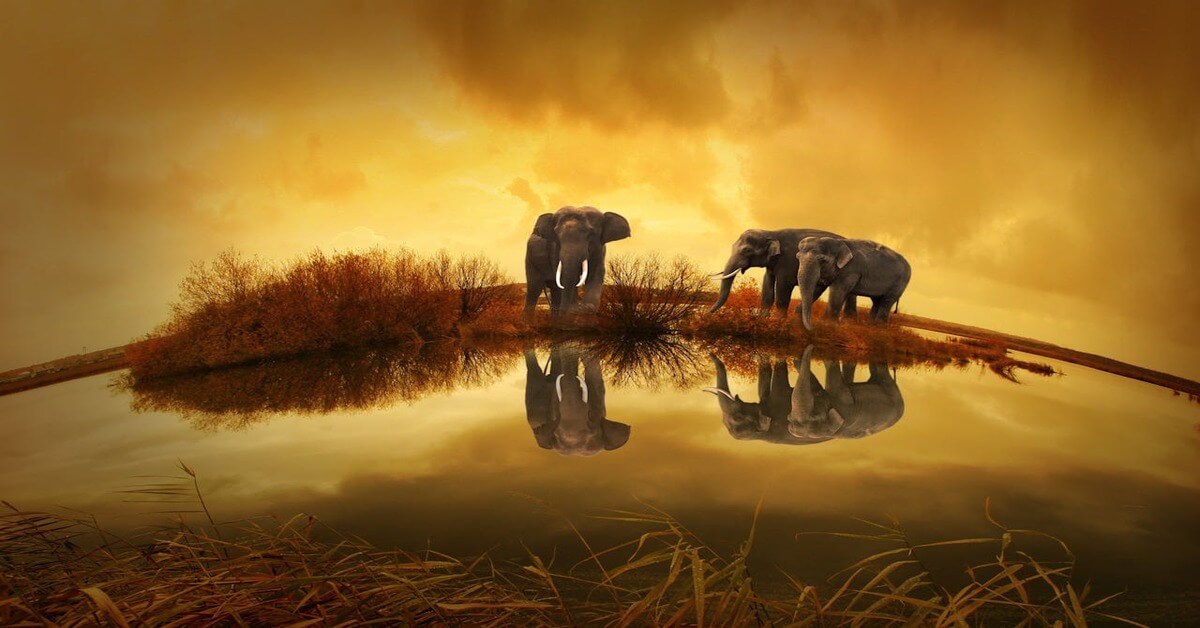
"Elefant" is masculine in German — the correct article is der. The plural is die Elefanten (add -en). In English, Elefant means "elephant".
Gender rule: Many large animal names are masculine in German — der Elefant, der Löwe, der Tiger. But there is an important grammar point here: Elefant follows the N-Deklination (weak declension), which means it adds -en in almost every case except the nominative singular. See all gender patterns in the Article Rules and a full overview of articles at the German articles.
Der Elefant is A1–A2 vocabulary and one of the most recognisable animal nouns in German. It is also an important example of the N-Deklination — a special declension pattern that many learners overlook. Understanding how cases work with nouns like Elefant will help you avoid one of the most common written mistakes. Below you'll find the full declension table, example sentences, a common mistake to avoid, and a short quiz.
Elefant — Declension Table
| Case | Singular | Plural |
|---|---|---|
| Nominative | der Elefant | die Elefanten |
| Genitive | des Elefanten | der Elefanten |
| Dative | dem Elefanten | den Elefanten |
| Accusative | den Elefanten | die Elefanten |
Example Sentences with Elefant
Der Elefant trinkt Wasser aus dem Fluss.
(The elephant drinks water from the river.) — Nominative
Die Kinder beobachten den Elefanten sehr aufmerksam.
(The children watch the elephant very attentively.) — Accusative
Der Pfleger gibt dem Elefanten täglich frisches Obst.
(The keeper gives the elephant fresh fruit every day.) — Dative
Der Rüssel des Elefanten ist sehr kräftig und beweglich.
(The elephant's trunk is very strong and flexible.) — Genitive
Die Elefanten laufen langsam durch die Savanne.
(The elephants walk slowly through the savannah.) — Nominative Plural
Der Fotograf folgt den Elefanten durch den Busch.
(The photographer follows the elephants through the bush.) — Dative Plural
Related Words & Compounds
Word family (Wortfamilie): die Elefantin (female elephant)
Common compounds (Komposita): das Elefantenbaby (elephant calf), der Elefantenbulle (bull elephant), der Elefantenrüssel (elephant's trunk), die Elefantenhaut (elephant skin), der Elefantenzahn (elephant tusk), die Elefantenherde (herd of elephants), das Elefantengedächtnis (elephant memory — idiom for excellent memory)
Common Mistake with Elefant
❌ Common mistake: Der Rüssel des Elefants ist sehr lang.
✅ Correct: Der Rüssel des Elefanten ist sehr lang.
💡 Why: Because Elefant follows the N-Deklination, it adds -en in the genitive — not just -s like regular masculine nouns (e.g. des Hundes). The form "des Elefants" looks logical by analogy, but it is wrong. Any time you use Elefant outside the nominative singular, add -en: den Elefanten, dem Elefanten, des Elefanten.
Quick Quiz: Test Your Knowledge
Can you get all three right? Apply what you've learned above.
1. Wir sehen ___ Elefant___ jeden Tag im Zoo.
- A) der Elefant
- B) den Elefant
- C) den Elefanten
Check Answer
"Sehen" (to see) takes the accusative. Masculine accusative = den. Because Elefant follows the N-Deklination, the noun itself also adds -en: den Elefanten. Option B) is wrong because it uses the accusative article but forgets the -en ending on the noun.
2. Das Tier wartet geduldig neben ___ Elefant___.
- A) dem Elefant
- B) den Elefanten
- C) dem Elefanten
Check Answer
"Neben" describes a location here (waiting next to), so it requires the dative. Masculine dative = dem. With N-Deklination, the noun adds -en: dem Elefanten. Option A) has the right article but misses the -en ending on the noun — a very common mistake with this word.
3. Das ist ein sehr intelligent___ Elefant.
- A) -e
- B) -er
- C) -en
Check Answer
After an indefinite article in the nominative with a masculine noun, the adjective ending is -er: ein intelligenter Elefant. The adjective must carry the gender signal because ein doesn't show it. Compare: feminine eine intelligente Katze (-e), neuter ein intelligentes Pferd (-es).
Want to drill more nouns like this? The Article Trainer gives you 600+ nouns to practice — pick the article, get instant feedback, and stop guessing.
More Animal Nouns
- der Hund — the dog
- die Katze — the cat
- das Pferd — the horse
- die Maus — the mouse
- der Löwe — the lion
- der Tiger — the tiger
- die Giraffe — the giraffe
- das Krokodil — the crocodile
For more animal words, explore the full animal vocabulary list.
Is it der, die, or das Elefant? Practice makes perfect.
The Article Trainer gives you 600+ nouns to drill — including animal vocabulary and much more. Pick the article, get instant feedback, and stop guessing.
Practice German Articles →Frequently Asked Questions
Is Elefant masculine, feminine, or neuter in German?
Elefant is masculine — the correct article is der. This fits the common pattern that many large animal names are masculine in German. However, Elefant belongs to a special group called the N-Deklination, which means it adds -en in all cases except the nominative singular. See all gender patterns in the Article Rules.
What is the plural of Elefant?
The plural is die Elefanten — add -en to the singular. This follows directly from the N-Deklination pattern. In the dative plural, no extra -n is needed since the noun already ends in -en: den Elefanten.
What is the N-Deklination and why does Elefant follow it?
The N-Deklination is a weak declension pattern that applies to a group of masculine nouns — typically those ending in -ant, -ent, -ist, -oge, or referring to living beings (e.g. der Student, der Mensch, der Junge). These nouns add -en in all cases except the nominative singular. Elefant ends in -ant, which is one of the clearest signals for this pattern.
How do you say "the elephant's trunk" in German?
You say der Rüssel des Elefanten. The genitive is used to express possession. Note that the genitive form is des Elefanten — not des Elefants — because of the N-Deklination. In informal spoken German, you might also hear der Rüssel vom Elefanten, using von + dative as an alternative.