
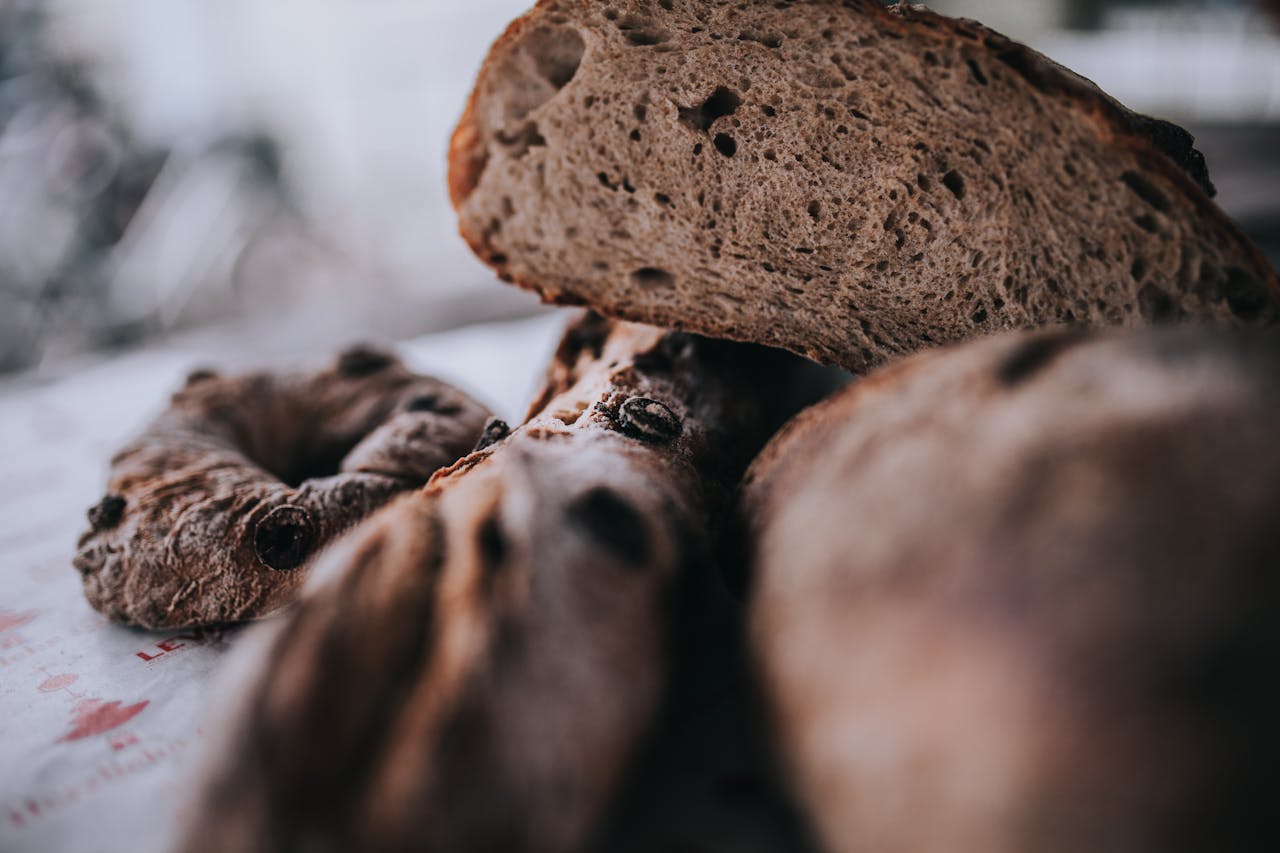
Brot is neuter in German — the correct article is das. The plural is die Brote. In English, Brot translates to bread.Das Brot is an absolute staple in the German food and drinks vocabulary. Bread is a central part of German culture, so you will encounter this word daily, whether at a bakery (Bäckerei) or during dinner (Abendbrot). Below you'll find the full declension, example sentences, and a quiz.
Gender rule: As a short, monosyllabic Germanic root word, there is no clear ending-based rule for Brot — the article must be memorized. See all gender patterns in the Article Rules and a full overview at the German Articles.
Brot — Declension Table
| Case | Singular | Plural |
|---|---|---|
| Nominative | das Brot | die Brote |
| Genitive | des Brotes / des Brots | der Brote |
| Dative | dem Brot | den Broten |
| Accusative | das Brot | die Brote |
Example Sentences with Brot
Das frische Brot duftet wunderbar.
(The fresh bread smells wonderful.) — Nominative
Ich schneide das Brot in dicke Scheiben.
(I am cutting the bread into thick slices.) — Accusative
Er isst die heiße Suppe mit dem Brot.
(He eats the hot soup with the bread.) — Dative
Die Kruste des Brotes ist sehr knusprig.
(The crust of the bread is very crispy.) — Genitive
Die Brote beim Bäcker sehen köstlich aus.
(The breads at the bakery look delicious.) — Nominative Plural
Zu den Broten servieren wir Käse und Wurst.
(We serve cheese and cold cuts with the breads.) — Dative Plural
Related Words & Compounds
Word family (Wortfamilie): das Brötchen (bread roll — diminutive)
Common compounds (Komposita): das Schwarzbrot (black bread/rye bread), das Vollkornbrot (whole grain bread), das Abendbrot (dinner/supper), die Brotdose (lunchbox)
Common Mistake with Brot
❌ Common mistake: Die Broten sind noch warm.
✅ Correct: Die Brote sind noch warm.
💡 Why: The standard plural form of das Brot is die Brote (adding just an "-e"). You only add an "-n" in the dative plural (den Broten). When it acts as the subject of the sentence in the nominative case, using "Broten" is grammatically incorrect.
Quick Quiz: Test Your Knowledge
Can you get all three right? Apply what you've learned above.
1. Der Preis ___ ist im letzten Jahr gestiegen.
- A) das Brot
- B) des Brotes
- C) dem Brot
Check Answer
"Der Preis des Brotes" — the genitive case shows possession or relation (the price of what?). Neuter genitive = des + noun adds -es or -s: des Brotes.
2. ___ schmeckt am besten mit etwas Butter.
- A) Das Brot
- B) Dem Brot
- C) Den Brot
Check Answer
Here, the bread is the subject of the sentence, so it must be in the nominative case. Neuter nominative = das: Das Brot.
3. Sie kauft ein frisch___ Brot beim Bäcker.
- A) -es
- B) -en
- C) -e
Check Answer
After the indefinite article ein in the accusative neuter, the adjective ending is -es: ein frisches Brot. The adjective takes over the gender signal that "ein" doesn't show.
Want to practice more nouns like this? The Article Trainer has 600+ nouns to drill — including everyday vocabulary. Pick the article, get instant feedback, and stop guessing.
More Food Nouns & Vocabulary
- der Apfel — the apple
- die Banane — the banana
- die Orange — the orange
- die Butter — the butter
- der Käse — the cheese
- die Wurst — the sausage / cold cuts
For more themed vocabulary lists, explore the Vocabulary overview list, practice with the food and drinks vocabulary, or browse the full grammar overview to master your German.
Is it der, die, or das? Practice makes perfect.
The Article Trainer gives you 600+ nouns to drill — including everyday vocabulary. Pick the article, get instant feedback, and stop guessing.
Practice German Articles →Frequently Asked Questions
Is Brot masculine, feminine, or neuter in German?
Brot is neuter — the correct article is das. Because it is a short, original Germanic word, there is no specific ending-based rule to predict its gender, so you have to memorize it. However, the gender "das" applies to all types of bread when it's part of a compound word (e.g., das Vollkornbrot, das Weißbrot).
What is the plural of Brot in German?
The plural of das Brot is die Brote. You simply add an "-e" to the end of the word. A common mistake is adding an "-n" (Broten), but that is only used in the dative plural case (den Broten).
What is a Brötchen?
Das Brötchen is a diminutive form of Brot, literally meaning "little bread." It translates to "bread roll" in English. Like all German nouns ending in the diminutive suffix -chen, it is always neuter (das).