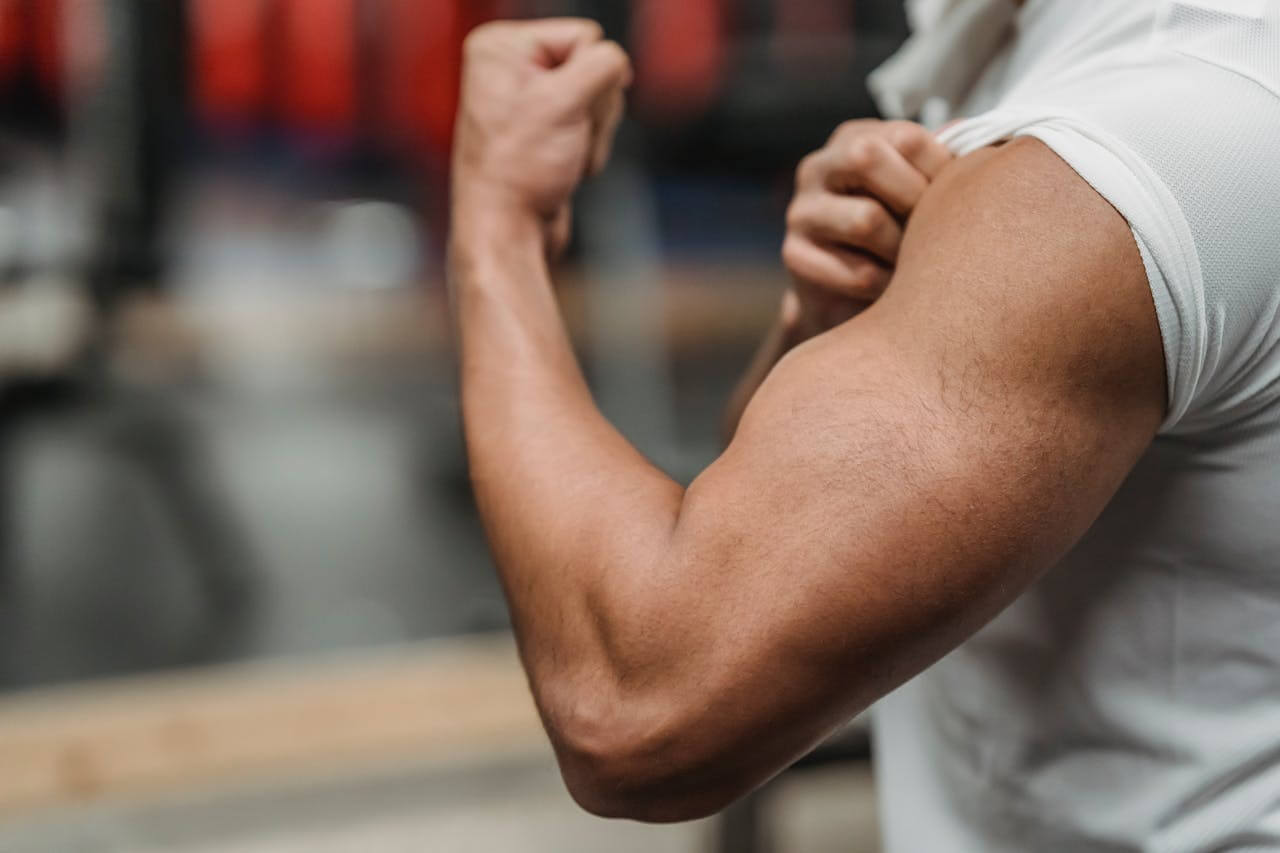
"Muskel" is masculine in German — the correct article is der. The plural is die Muskeln. In English, Muskel means "muscle".
Gender rule: der Muskel is masculine. It is a loanword from Latin musculus, and its gender must simply be learned — there is no reliable ending-based rule for body part nouns in German. The safest approach is always to learn every noun with its article from the start. See all gender patterns in the Article Rules and a full overview at the german articles.
Der Muskel is an A1–A2 vocabulary word that comes up constantly in sport, fitness, and medical contexts. Its plural adds -n: die Muskeln — a common pattern for masculine nouns ending in -el. Because der Muskel is a loanword, English speakers sometimes mistakenly apply an -s plural — making the plural one of the key things to learn here. Understanding how cases work with masculine nouns like der Muskel is an important step at A1–A2 level. For more body part nouns, also see der Arm and der Knochen.
Muskel — Declension Table
| Case | Singular | Plural |
|---|---|---|
| Nominative | der Muskel | die Muskeln |
| Genitive | des Muskels | der Muskeln |
| Dative | dem Muskel | den Muskeln |
| Accusative | den Muskel | die Muskeln |
Example Sentences with Muskel
Sein Muskel zuckt unwillkürlich nach dem intensiven Training.
(His muscle twitches involuntarily after the intense training session.) — Nominative
Sie massiert den Muskel vorsichtig, bis die Spannung nachlässt.
(She massages the muscle carefully until the tension eases.) — Accusative
Er fühlt einen stechenden Schmerz im Muskel nach dem Sprint.
(He feels a sharp pain in the muscle after the sprint.) — Dative
Die Dehnung des Muskels vor dem Sport kann Verletzungen vorbeugen.
(Stretching the muscle before sport can help prevent injuries.) — Genitive
Nach dem langen Training zittern ihre Muskeln vor Erschöpfung.
(After the long training session, her muscles tremble with exhaustion.) — Nominative Plural
Regelmäßiges Dehnen tut den Muskeln nach intensiver Belastung sehr gut.
(Regular stretching is very good for the muscles after intense exertion.) — Dative Plural
Related Words & Compounds
Word family (Wortfamilie):
- muskulös — muscular (adjective, from the same Latin root musculus)
Common compounds (Komposita):
- der Muskelkater — delayed onset muscle soreness (DOMS)
- der Muskelkrampf — muscle cramp
- der Muskelaufbau — muscle building
- die Muskelgruppe — muscle group
Common Mistake with Muskel
❌ Common mistake: Seine Muskels sind sehr stark.
✅ Correct: Seine Muskeln sind sehr stark.
💡 Why: The plural of der Muskel is die Muskeln — not Muskels. Although der Muskel is a loanword from Latin, it has fully adopted a standard German plural pattern: masculine nouns ending in -el typically add -n in the plural. The -s plural does not apply here.
Quick Quiz: Test Your Knowledge
Can you get all three right? Apply what you've learned above.
1. Er spürt einen Schmerz in ___ Muskel nach dem Training.
- A) den
- B) des
- C) dem
Check Answer
Im is a contraction of in dem — the preposition in here indicates a fixed location (where does he feel the pain?), which requires the dative case. For masculine nouns, the dative article is dem: im Muskel. Option A) den is accusative. Option B) des is genitive.
2. Die Dehnung ___ Muskels vor dem Sport beugt Verletzungen vor.
- A) dem
- B) der
- C) des
Check Answer
"Die Dehnung ___ Muskels" — whose stretching? The muscle's. This is a possession relationship expressed with the genitive case. For masculine nouns, the genitive article is des and the noun adds -s: des Muskels. Option A) dem is dative. Option B) der is the genitive article for feminine nouns.
3. Ein verletzt___ Muskel braucht Ruhe und Kühlung.
- A) -e
- B) -en
- C) -er
Check Answer
After an indefinite article in the nominative with a masculine noun, the adjective ending is -er: ein verletzter Muskel. Because ein does not carry a visible masculine signal in the nominative (it looks the same as neuter ein), the adjective must carry the gender signal — this is the strong ending -er. Option A) -e is used after a definite article in the nominative. Option B) -en is the weak ending used in most other case-gender combinations.
Want to drill more nouns like this? The Article Trainer gives you 600+ nouns to practice — pick the article, get instant feedback, and stop guessing.
More Body Part Nouns
- der Arm — the arm
- der Bauch — the belly / stomach
- das Bein — the leg
- der Finger — the finger
- das Gesicht — the face
- der Hals — the neck / throat
- die Hand — the hand
- das Herz — the heart
- die Haut — the skin
- das Knie — the knee
- der Knochen — the bone
- der Kopf — the head
For the full list with articles and plurals, see the Body Parts Vocabulary page. You can also browse more topic-based word lists in the German Vocabulary Overview and test yourself with the Vocabulary Quizzes.
Is it der, die, or das Muskel? Practice makes perfect.
The Article Trainer gives you 600+ nouns to drill — from everyday vocabulary to family, food, and much more. Pick the article, get instant feedback, and stop guessing.
Practice German Articles →Frequently Asked Questions
Is Muskel masculine, feminine, or neuter in German?
Muskel is masculine — the correct article is der. It is a loanword from Latin musculus, and its gender must simply be learned. The best habit is always to learn every noun with its article from the start. For a full overview of gender patterns, see the Article Rules.
What is the plural of Muskel in German?
The plural is die Muskeln — add -n. Do not use Muskels — the -s plural is rare in German and does not apply here. In the dative plural, no extra -n is added because the plural already ends in -n: den Muskeln.
What is der Muskelkater in German?
Der Muskelkater is the German word for delayed onset muscle soreness (DOMS) — the aching sensation in muscles that typically appears one to two days after intense exercise. The word is a compound of Muskel (muscle) and Kater (tomcat — also used colloquially for a hangover). In everyday German, Muskelkater haben (to have muscle soreness) is a very common phrase.
What is the genitive of der Muskel?
The genitive singular is des Muskels — add -s. This is the standard pattern for masculine nouns ending in -el. The genitive plural is der Muskeln. See the Cases Overview for more detail.