
The German Cases: German has four grammatical cases — nominative (subject), genitive (possession), dative (indirect object), and accusative (direct object). Cases change the form of articles, pronouns, and adjectives to show each noun’s role in a sentence. Unlike English, which relies on word order, German uses case endings to mark grammatical function — which is why der Mann can become des Mannes, dem Mann, or den Mann depending on its role. The fastest way to spot a case is its question word: Wer? (nominative), Wessen? (genitive), Wem? (dative), Wen? (accusative).
If you have ever wondered why der sometimes turns into des, dem, or den — welcome to one of the most important topics in the German language. For native English speakers, cases are often the first real hurdle, because English barely uses them. But once you understand the logic, a huge part of German grammar suddenly clicks into place.
German has four cases: nominative, genitive, dative, and accusative. Each tells you what job a noun is doing — subject, possessor, indirect object, or direct object. This guide walks through every case with clear charts, real example sentences (all translated), interactive quizzes, and memory tricks.
Key Takeaways
- German has four cases: nominative (subject), genitive (possession), dative (indirect object), accusative (direct object).
- Find the case by asking a question word: Wer? → nominative, Wessen? → genitive, Wem? → dative, Wen/Was? → accusative.
- Cases change articles, pronouns, and adjective endings — so you must know the noun’s gender first (der, die, das).
- Prepositions and certain verbs are signal words: they force a specific case every time.
- Beginners: learn nominative and accusative first, then dative, and genitive last.
What Are German Cases? (And Why They Matter)
A case is simply a label for the role a noun plays in a sentence. Every noun has a job, and the case tells everyone — reader or listener — exactly what that job is. There are four jobs, and therefore four cases:
← swipe to see the full table →
| Case | German Name | Question Word | Function |
|---|---|---|---|
| Nominative | Nominativ — 1. Fall (Wer-Fall) | Wer? / Was? (Who? / What?) | Subject — who does the action |
| Genitive | Genitiv — 2. Fall (Wessen-Fall) | Wessen? (Whose?) | Possession — whose it is |
| Dative | Dativ — 3. Fall (Wem-Fall) | Wem? (To/for whom?) | Indirect object — who receives |
| Accusative | Akkusativ — 4. Fall (Wen-Fall) | Wen? / Was? (Whom? / What?) | Direct object — what is affected |
The four cases follow the traditional German numbering: nominative is the 1. Fall, genitive the 2. Fall, dative the 3. Fall, and accusative the 4. Fall. This guide follows that order. That said, if you are just starting out, many teachers recommend learning nominative and accusative first, then dative, and saving genitive for last — that matches how often you use them in everyday conversation.
How Do Cases Work in English?
Here is the good news for English speakers: English has cases too — you just only see them in pronouns. You already use them every day without thinking:
- I see him. (subject) — he sees me. (object) — that is my book. (possession)
- Other pairs: he / him / his, she / her / her, we / us / our, they / them / their, who / whom / whose.
Those changes are exactly what cases do. Map them onto German and the system stops feeling foreign:
← swipe to see the full table →
| Role | English form | German case |
|---|---|---|
| Subject | I / he / who | Nominative |
| Possession | my / his / whose | Genitive |
| Indirect object | (to) me / him / whom | Dative |
| Direct object | me / him / whom | Accusative |
Two differences: English lost its case endings on nouns centuries ago (it kept them only on pronouns), while German kept the full system and applies it to articles too (der → den → dem → des). And English merges the indirect and direct object into one “objective” form (me, him), whereas German keeps dative and accusative separate. Once you see he→I, him→me, his→my as the same idea behind der→den→des, cases click.
Why German Has Cases (And English Mostly Doesn’t)
In English, word order tells you who does what. “The dog bites the man” means something completely different from “The man bites the dog.” German works differently: it is an inflected language, changing the form of articles, pronouns, and adjectives to show a noun’s role. These changes are called case endings, and applying them is called declension (Deklination). Because of declension, German word order is far more flexible, and roles stay unambiguous no matter the order.
Look at this: Der Hund beißt den Mann. (The dog bites the man.) Rearranged: Den Mann beißt der Hund. — the meaning is exactly the same! The dog is still biting. How do we know? Because den Mann carries the accusative ending, marking it as the direct object wherever it sits. That flexibility is the whole point of cases — but it means you need to learn which ending to use and when.
What Changes When You Use Different Cases?
Three types of words change form depending on the case:
1. Articles — definite (der, die, das) and indefinite (ein, eine) both change. Possessive articles (mein, dein, sein, ihr) and kein follow the same pattern as ein. See the German article rules.
2. Pronouns — ich becomes mich (accusative) or mir (dative).
3. Adjective endings — they change with case, gender, and article type. See adjective declension.
An important point: to apply the correct case, you first need the noun’s gender (masculine, feminine, or neuter). That is why learning der, die, das for every noun is so essential — without the gender, you cannot choose the right form. Here is one noun, der Mann, in all four cases:
← swipe to see the full table →
| Case | Article + Noun | Example Sentence | Translation |
|---|---|---|---|
| Nominative | der Mann | Der Mann arbeitet hier. | The man works here. |
| Genitive | des Mannes | Das Auto des Mannes ist blau. | The man’s car is blue. |
| Dative | dem Mann | Ich gebe dem Mann einen Kaffee. | I give the man a coffee. |
| Accusative | den Mann | Ich sehe den Mann. | I see the man. |
German Cases Chart
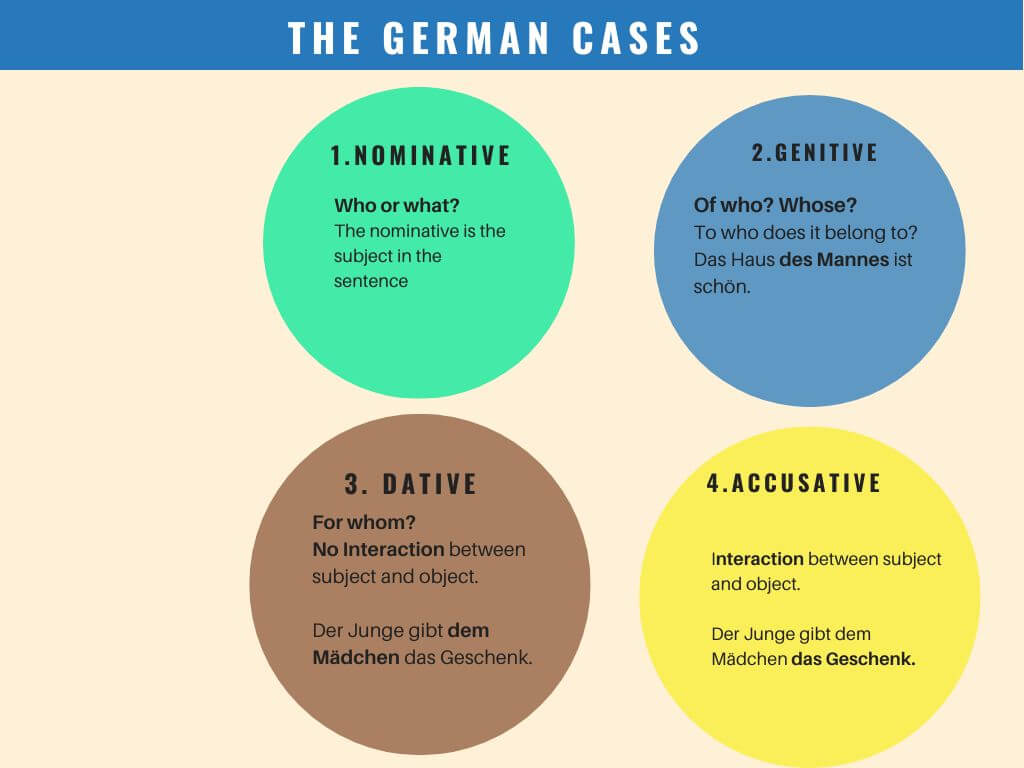
The chart above gives a quick visual overview. Below is the complete German cases table showing how definite and indefinite articles change in every case — the table you will come back to again and again:
← swipe to see the full table →
| Case | Fragewort | Function | Masculine | Feminine | Neuter | Plural |
|---|---|---|---|---|---|---|
| Nominative | Wer/Was? | Subject | der / ein | die / eine | das / ein | die / – |
| Genitive | Wessen? | Possession | des / eines (+s/es) | der / einer | des / eines (+s/es) | der / – |
| Dative | Wem? | Indirect Object | dem / einem | der / einer | dem / einem | den / – (+n) |
| Accusative | Wen/Was? | Direct Object | den / einen | die / eine | das / ein | die / – |
A few patterns to notice: feminine and plural articles stay the same in nominative and accusative — only masculine changes (der → den). In the dative, all genders change. In the genitive, masculine and neuter nouns add -s or -es to the noun itself. The possessive articles (mein, dein, sein, ihr, unser, euer) and kein follow the exact same pattern as ein. These same patterns also drive adjective endings, so learning them now pays off twice.
Every case starts with one question: der, die, or das?
The whole table above hinges on knowing the noun’s gender. Get that wrong and every case form is a guess. The Article Trainer drills the gender of 1,000+ essential nouns filtered to your level (A1–C1), explains the rule behind every mistake, and uses spaced repetition so the genders become automatic — the foundation the entire case system is built on.
Built by the native German tutor Niko with 5,000+ lessons taught · Lifetime access · 14-day money-back guarantee
Get the Article Trainer — $65 →The Nominative Case (Nominativ) — The Subject
The nominative case (Nominativ, 1. Fall, the Wer-Fall) marks the subject — the person or thing performing the action. Ask: Wer? (Who?) or Was? (What?). It is also the base form you find in the dictionary. The nominative is used after sein (to be), werden (to become), and bleiben (to stay) — the predicate nominative: Er ist ein guter Lehrer. (He is a good teacher.) Full guide: the nominative case.
| Nominativ | Beispielsatz | Translation |
|---|---|---|
| Der Mann | Der Mann geht jeden Morgen spazieren. | The man goes for a walk every morning. |
| Die Familie | Die Familie fährt in den Urlaub. | The family is going on vacation. |
| Das Mädchen | Das Mädchen liest ein Buch. | The girl reads a book. (das Mädchen — neuter!) |
| Die Schüler | Die Schüler lernen für die Prüfung. | The students are studying for the exam. |
| Er | Er wird ein bekannter Arzt. | He will become a well-known doctor. (nom. after werden) |
Quick Check: ___ Hund bellt laut.
a) Den b) Der c) Dem d) Des
Show Answer
✅ b) Der — “Der Hund” is the subject (nominative). Ask: Wer bellt? (Who is barking?) → Der Hund.
The Genitive Case (Genitiv) — Possession
The genitive case (Genitiv, 2. Fall, the Wessen-Fall) shows possession or a relationship between two nouns — like ‘s or of in English. Ask: Wessen? (Whose?). It has the most visible endings: masculine and neuter nouns add -s or -es. Full guide: the genitive case.
The genitive is the most advanced of the four cases. Beginners can focus on nominative and accusative first, then dative, and add genitive once those are solid — but it is essential for formal writing and German exams.
| Genitiv | Beispielsatz | Translation |
|---|---|---|
| des Mannes | Das Auto des Mannes ist blau. | The man’s car is blue. |
| der Frau | Die Tasche der Frau ist rot. | The woman’s bag is red. |
| des Kindes | Das Spielzeug des Kindes liegt auf dem Boden. | The child’s toy is on the floor. |
| des Bruders | Das Fahrrad des Bruders ist neu. | The brother’s bicycle is new. |
| der Schüler | Die Hausaufgaben der Schüler sind fertig. | The students’ homework is done. (plural — no extra ending) |
Genitive Prepositions
These genitive prepositions are signal words — whenever you see one, the genitive follows: wegen (because of), während (during), trotz (despite), (an)statt (instead of), innerhalb (within), außerhalb (outside of), aufgrund (due to). Examples: Trotz des schlechten Wetters gehen wir spazieren. (Despite the bad weather, we go for a walk.) — Während des Unterrichts darf man nicht telefonieren. (During class you may not use the phone.) Note: in casual speech, a few of these (trotz, wegen) are often used with the dative. See also genitive verbs.
Genitive vs. “von + Dative” in Spoken German
In everyday spoken German, the genitive is often replaced by von + dative. Instead of “das Auto des Mannes“ you will often hear “das Auto von dem Mann.” Both are fine. But in formal writing, academic contexts, and exams (Goethe B1 and above), the genitive is expected — so master it if you are preparing for a certificate.
Quick Check: Trotz ___ Regens gehen wir wandern.
a) dem b) den c) des d) der
Show Answer
✅ c) des — “Trotz” is a genitive preposition (signal word!). Der Regen → des Regens.
The Dative Case (Dativ) — The Indirect Object
The dative case (Dativ, 3. Fall, the Wem-Fall) marks the indirect object — who receives or benefits from an action. Ask: Wem? (To/for whom?). Full guide: the dative case.
In the dative, all articles change: der → dem, die → der, das → dem, die (plural) → den. Plural nouns also add -n if they don’t already end in one (die Kinder → den Kindern).
| Dativ | Beispielsatz | Translation |
|---|---|---|
| dem Mann | Ich gebe dem Mann ein Geschenk. | I give the man a gift. |
| der Frau | Sie hilft der Frau beim Einkaufen. | She helps the woman with the shopping. |
| dem Kind | Er liest dem Kind eine Geschichte vor. | He reads the child a story. |
| dem Kunden | Die Verkäuferin zeigt dem Kunden das Produkt. | The saleswoman shows the customer the product. |
| dir | Ich antworte dir sofort. | I answer you right away. |
| den Freunden | Er hat den Freunden eine Nachricht geschickt. | He sent his friends a message. (dative plural: +n) |
Note: der Kunde follows the N-Deklination — it adds -n in every case except the nominative singular.
Dative Prepositions
These dative prepositions always require the dative: aus (out of), außer (except), bei (at/near), mit (with), nach (after/to), seit (since), von (from/by), zu (to), gegenüber (opposite), ab (from/as of).
Examples: Ich fahre mit dem Bus. (I take the bus.) — Sie kommt aus der Schweiz. (She comes from Switzerland.) — Er wohnt bei seiner Mutter. (He lives with his mother.)
Important Dative Verbs
These verbs take the dative even though the English equivalent uses a direct object — the number one mistake English speakers make. Key dative verbs: helfen (to help), danken (to thank), gefallen (to please), gehören (to belong to), folgen (to follow), antworten (to answer), glauben (to believe), gratulieren (to congratulate), passen (to fit/suit), schmecken (to taste). Example: Ich helfe dem Onkel. (I help the uncle.) — NOT Ich helfe den Onkel!
Quick Check: Ich gehe mit ___ Freundin ins Kino.
a) die b) der c) den d) dem
Show Answer
✅ b) der — “mit” always takes the dative. Die Freundin → der Freundin (die → der for feminine dative).
The Accusative Case (Akkusativ) — The Direct Object
The accusative case (Akkusativ, 4. Fall, the Wen-Fall) marks the direct object — the person or thing directly affected. Ask: Wen? (Whom?) or Was? (What?). Full guide: the accusative case.
The key pattern: in the accusative, only the masculine article changes — der → den, ein → einen. Feminine, neuter, and plural keep the nominative form. That makes the accusative the easiest case after the nominative. Struggling with accusative vs. dative? See our dative vs. accusative guide.
| Akkusativ | Beispielsatz | Translation |
|---|---|---|
| den Ball | Ich werfe den Ball. | I throw the ball. (masc. der → den) |
| den Hund | Sie füttert den Hund. | She feeds the dog. (masc. der → den) |
| die Aufgabe | Er löst die Aufgabe schnell. | He solves the task quickly. (fem. — no change) |
| das Buch | Sie liest das Buch. | She reads the book. (neuter — no change) |
| einen Kuchen | Er backt einen Kuchen. | He bakes a cake. (masc. ein → einen) |
| keinen Kaffee | Ich trinke keinen Kaffee. | I don’t drink coffee. (kein follows the ein-pattern) |
Accusative Prepositions
These accusative prepositions always require the accusative: durch (through), für (for), gegen (against), ohne (without), um (around), bis (until), entlang (along).
Examples: Wir fahren durch den Tunnel. (We drive through the tunnel.) — Das Geschenk ist für meine Mutter. (The gift is for my mother.) — Er geht ohne seinen Freund. (He goes without his friend.)
Common Accusative Verbs
Most German verbs take an accusative object: haben (to have), sehen (to see), kaufen (to buy), brauchen (to need), kennen (to know a person), lieben (to love), essen (to eat), trinken (to drink), lesen (to read), finden (to find), besuchen (to visit).
Quick Check: Ich kaufe ___ Buch.
a) der b) das c) dem d) des
Show Answer
✅ b) das — “das Buch” is the direct object (accusative). Neuter articles don’t change in the accusative, so it stays das.
German Articles in Different Cases
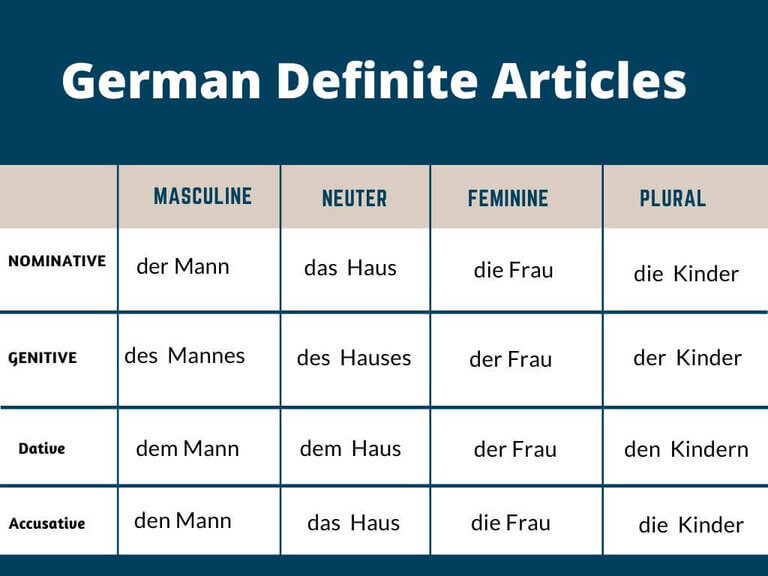
German articles reflect the case, number, and gender of the noun. Definite articles (der, die, das) and indefinite articles (ein, eine) change form by case; possessive articles and kein follow the ein-pattern. For example, masculine der becomes des (gen.), dem (dat.), and den (acc.). Not sure when to use which? See definite vs. indefinite articles.
Definite Articles Chart
Indefinite Articles Chart
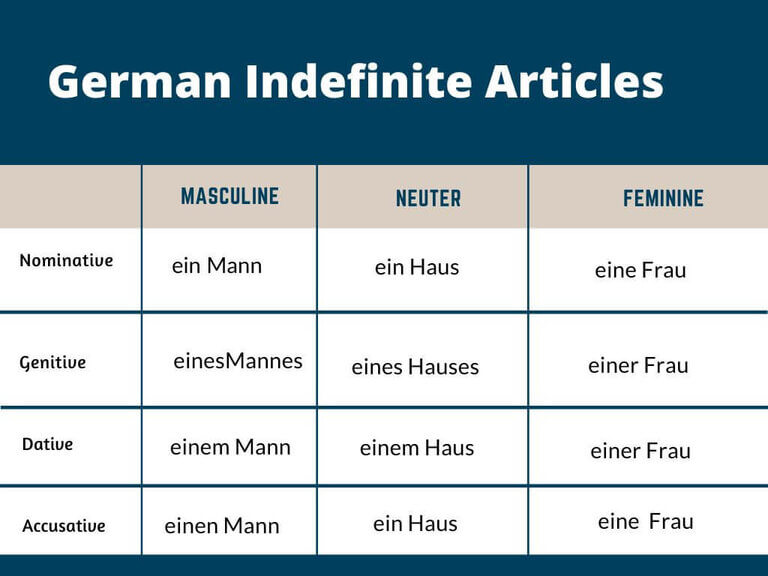
Since mein, dein, sein, ihr, kein and the other possessive articles follow this exact pattern, mastering the ein-declension covers a huge part of German grammar. For the rules behind gender, see the article rules, and for plural forms, German plural nouns.
Using Cases with German Prepositions
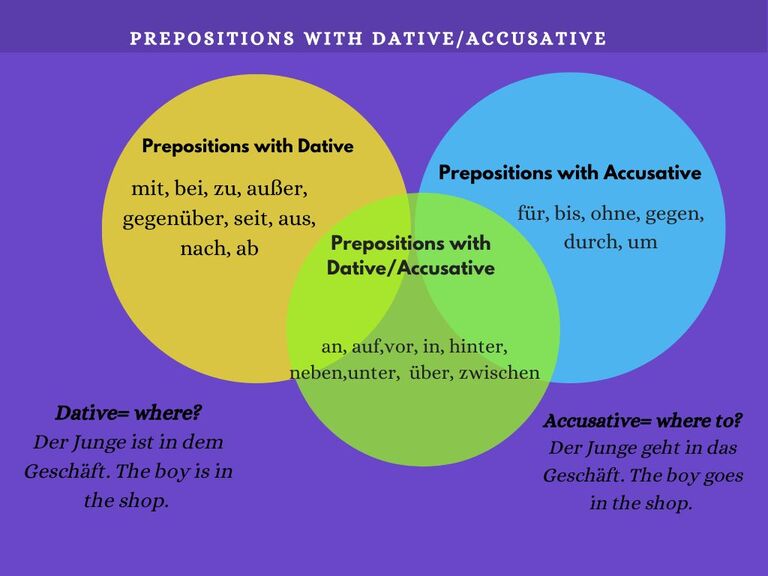
Prepositions are among the strongest signal words in German — they often tell you immediately which case to use. Some always take the same case; nine special two-way prepositions take either accusative or dative.
← swipe to see the full table →
| Case | Prepositions |
|---|---|
| Genitive | wegen, während, trotz, (an)statt, innerhalb, außerhalb, aufgrund |
| Dative | aus, außer, bei, mit, nach, seit, von, zu, gegenüber, ab |
| Accusative | durch, für, gegen, ohne, um, bis, entlang |
| Two-Way (Dat/Akk) | an, auf, hinter, in, neben, über, unter, vor, zwischen |
Two-Way Prepositions (Wechselpräpositionen)
Two-way prepositions are the trickiest part of the case system. The rule is about direction toward a goal, not just any movement:
- Direction / change of location from A to B (Wohin? — where to?) → accusative.
- Fixed location or position (Wo? — where?) → dative.
Compare these pairs (dative = location, accusative = direction):
← swipe to see the full table →
| Dative (location — Wo?) | Accusative (direction A→B — Wohin?) |
|---|---|
| Ich bin in der Schule. (I am in school.) | Ich gehe in die Schule. (I go to school.) |
| Die Tasse steht auf dem Tisch. (The cup is on the table.) | Er stellt die Tasse auf den Tisch. (He puts the cup on the table.) |
| Das Buch liegt in der Tasche. (The book is in the bag.) | Ich lege das Buch in die Tasche. (I put the book in the bag.) |
Cases and German Pronouns
German personal pronouns change by case, just like articles — ich becomes mir (dative) or mich (accusative). Here is the full table:
← swipe to see the full table →
| Nominative | Dative | Accusative | |
|---|---|---|---|
| I | ich | mir | mich |
| you (informal) | du | dir | dich |
| he | er | ihm | ihn |
| she | sie | ihr | sie |
| it | es | ihm | es |
| we | wir | uns | uns |
| you all | ihr | euch | euch |
| they | sie | ihnen | sie |
| you (formal) | Sie | Ihnen | Sie |
Examples: Kannst du mir bitte das Salz geben? (Can you please pass me the salt?) — “mir” is dative (Wem?), “das Salz” is accusative (Was?). Ich sehe ihn jeden Tag. (I see him every day.) — “ihn” is accusative (Wen?).
How Cases Affect Articles and Adjective Endings
Cases don’t work in isolation — they drive two other big topics. First, they change the articles (der → den → dem → des), which is why learning cases and articles together is so efficient. Second, they change adjective endings: the ending depends on the case, the gender, and the article type. der gute Mann (nom.) becomes dem guten Mann (dat.) becomes des guten Mannes (gen.). Once you know the cases, adjective endings become far more predictable — see the full system in German adjective endings.
How to Know Which Case to Use: A Step-by-Step Guide
Here is a practical process you can run every time you build a German sentence:
Step 1: Is there a preposition? If yes, the preposition decides the case (check the table above). If it is a two-way preposition, ask: destination A→B? → accusative. Fixed location? → dative.
Step 2: No preposition? Check the verb. Is it a dative verb (helfen, danken, gefallen, gehören, folgen, antworten…)? → dative. Is it sein, werden, or bleiben? → the noun after it stays nominative. Otherwise → the object is accusative.
Step 3: Identify the roles with the Fragewörter. Wer/Was? → nominative. Wessen? → genitive. Wem? → dative. Wen/Was? → accusative.
Apply it to a sentence with all four cases: Der Lehrer gibt dem Schüler den Stift des Direktors. (The teacher gives the student the principal’s pen.)
| Question (Fragewort) | Answer | Case |
|---|---|---|
| Wer gibt? (Who gives?) | der Lehrer | Nominative (1. Fall) |
| Wessen Stift? (Whose pen?) | des Direktors | Genitive (2. Fall) |
| Wem gibt er ihn? (To whom?) | dem Schüler | Dative (3. Fall) |
| Was gibt er? (What does he give?) | den Stift | Accusative (4. Fall) |
One sentence — all four German cases! Practice this kind of analysis and choosing the right case becomes second nature.
Common Mistakes with German Cases
After years of teaching German, these are the case mistakes that come up most — spotting them will instantly sharpen your accuracy.
Mistake 1: Using accusative with dative verbs
❌ Ich helfe dich. ✅ Ich helfe dir. (I help you.) — “helfen” always takes the dative; English “help” uses a direct object, which misleads learners.
Mistake 2: Wrong case with two-way prepositions
❌ Ich bin in die Schule. ✅ Ich bin in der Schule. (I am in school.) — “sein” is static (a location, not A→B), so dative.
Mistake 3: Forgetting the masculine accusative change
❌ Ich sehe der Mann. ✅ Ich sehe den Mann. (I see the man.) — masculine changes in the accusative (der → den); learners forget because feminine and neuter don’t.
Mistake 4: Missing the dative plural -n
❌ Ich spreche mit die Kinder. ✅ Ich spreche mit den Kindern. (I speak with the children.) — dative plural: die → den AND the noun adds -n.
Mistake 5: Forgetting the genitive noun ending
❌ Das Auto des Lehrer. ✅ Das Auto des Lehrers. (The teacher’s car.) — masculine and neuter nouns add -s or -es.
Mistake 6: Accusative instead of nominative after “sein”
❌ Er ist einen guten Lehrer. ✅ Er ist ein guter Lehrer. (He is a good teacher.) — after sein/werden/bleiben the noun stays nominative.
Mistake 7: Wrong pronoun case
❌ Ich gebe sie das Buch. ✅ Ich gebe ihr das Buch. (I give her the book.) — “geben” needs a dative recipient: sie → ihr.
Memory Tricks for German Cases
German Cases Quiz
Test all four cases below. Pick a, b, or c — you’ll see the correct answer and the rule right away.
1. Which fits? “___ Hund bellt laut.”
Correct: Der. The dog is the subject → nominative. Ask Wer bellt? → der Hund.
2. Which fits? “Ich sehe ___ Mann.”
Correct: den. The man is the direct object → accusative. Masculine der → den.
3. Which fits? “Ich helfe ___ Frau.”
Correct: der. helfen is a dative verb, so feminine die → der.
4. Which fits? “Das Auto ___ Mannes ist blau.”
Correct: des. This shows possession → genitive. Masculine der → des, and the noun adds -es (des Mannes).
5. Which fits? “Ich lege das Handy auf ___ Tisch.” (onto — Wohin?)
Correct: den. auf is a two-way preposition; here there’s a destination (A→B, Wohin?), so accusative: den Tisch.
Cases down? Adjective endings are the next step.
The four cases drive adjective endings too — same patterns, one more layer. The German Adjective Endings Practice Book takes you from A2 to C1 with 126 pages, 61 exercises, and full answer keys, built around the logic of weak, mixed, and strong endings so they finally stick.
Written by the native German tutor Niko · Instant PDF download
Get the eBook — $15.90 →Practice German Cases: Quizzes & Tools
Understanding the theory is essential, but using the right case automatically takes practice. Here is everything on this site to help you master cases:
Build your article instinct
Mastering der, die, das is the foundation for every case ending — without the gender, you can’t choose the right form. The Article Trainer makes it automatic with 1,000+ nouns, rule explanations, and spaced repetition.
Try the Article Trainer — $65 →Free German Cases Quizzes:
Explore all: Grammar Quizzes Overview
More Quick Checks
Quick Check: Das ist die Frau, ___ ich gestern begegnet bin.
a) die b) der c) den d) dem
Show Answer
✅ b) der — “begegnen” is a dative verb, so the feminine relative pronoun is der. This is a relative clause — relative pronouns follow the case system too.
Quick Check: Sie gibt ___ Mann einen Kaffee.
a) der b) den c) dem d) des
Show Answer
✅ c) dem — “dem Mann” is the indirect object (dative). Ask Wem gibt sie den Kaffee? → dem Mann.
Frequently Asked Questions About German Cases
What are the four German cases and when do you use them?
German has four cases: nominative (the subject — who does the action), genitive (possession — whose it is), dative (the indirect object — who receives), and accusative (the direct object — what is affected). Each changes the articles, pronouns, and adjectives around the noun.
How do I know which German case to use?
Follow three steps: (1) Is there a preposition? It decides the case. (2) What is the verb? Some verbs like helfen always take the dative; sein/werden/bleiben keep the nominative. (3) Ask the Fragewort — Wer? (nominative), Wessen? (genitive), Wem? (dative), Wen/Was? (accusative).
What is the difference between the accusative and dative case?
The accusative marks the direct object — what is directly affected (Wen/Was?). The dative marks the indirect object — who receives or benefits (Wem?). Example: Ich gebe dem Mann (dative) den Kaffee (accusative). See our dative vs. accusative guide.
What are two-way prepositions in German?
Nine prepositions — an, auf, hinter, in, neben, über, unter, vor, zwischen — take either case. Use the accusative for direction toward a goal (A→B, Wohin?) and the dative for a fixed location (Wo?).
What is the easiest way to learn German cases?
Learn nominative and accusative first (they cover most everyday sentences), then dative, and genitive last. Focus on the one big change — masculine der → den — then learn the prepositions and dative verbs as fixed signal words. Practise with short, regular sessions rather than cramming.
Do I need to learn the genitive case?
Yes, especially for written and formal German and exams (Goethe B1 and above). Spoken German often replaces it with von + dative, but genitive prepositions like wegen, trotz, and während are common even in everyday language.
Do German cases affect adjective endings?
Yes. Adjective endings change with the case, the noun’s gender, and the article type. This is called adjective declension and follows the same case patterns you learn here.
Why does German have cases but English doesn’t?
English used to have a full case system but lost most of it — it survives only in pronouns (I/me/my, he/him/his). German kept the whole system, which lets word order stay flexible because the case endings, not the order, show who does what.