
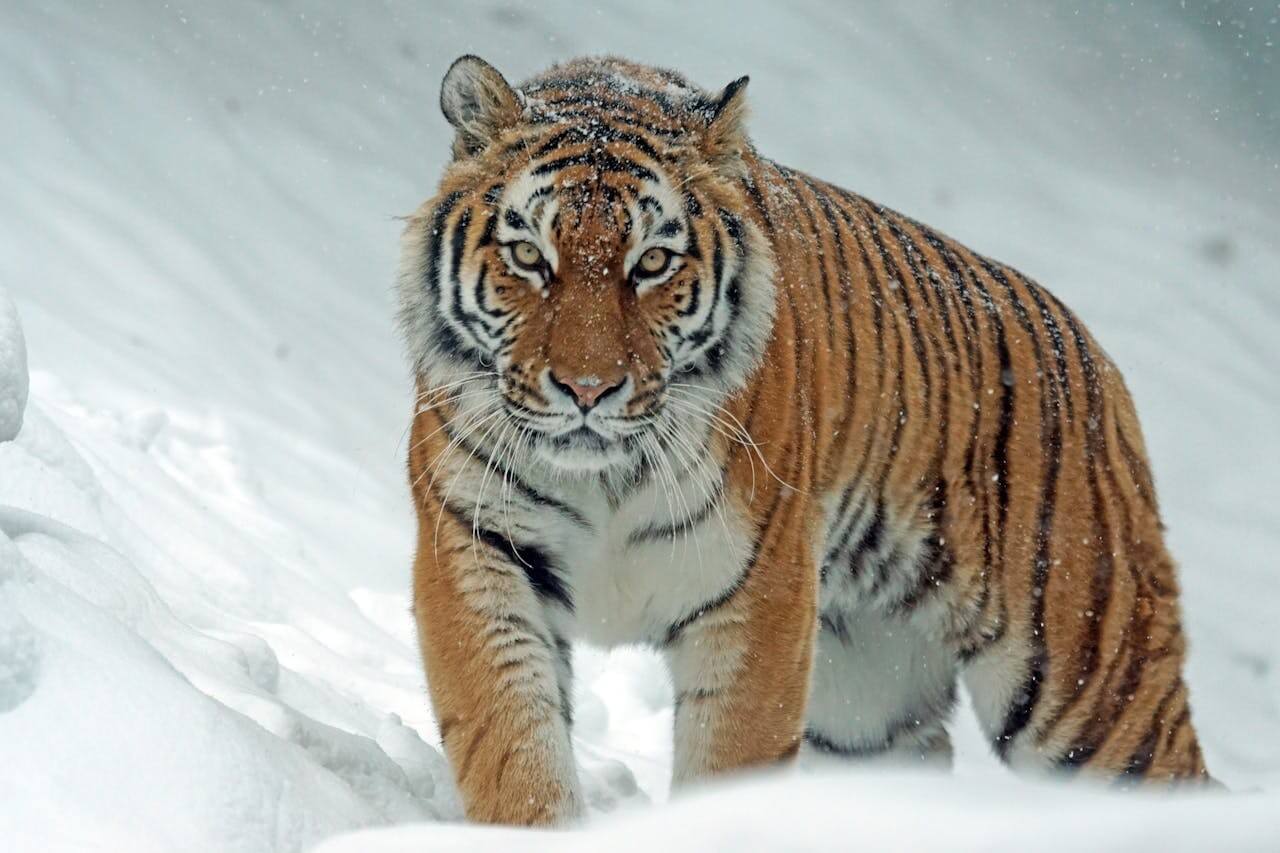
"Tiger" is masculine in German — the correct article is der. The plural is die Tiger — the form does not change. In English, Tiger means "tiger". The female tiger is die Tigerin.
Gender rule: The gender of animal nouns in German often has to be memorised individually. Der Tiger is masculine — the same as der Löwe and der Wolf. Note that the plural is identical to the singular: der Tiger → die Tiger. See all gender patterns in the Article Rules and a full overview at the German articles.
Der Tiger is A1–A2 vocabulary and one of the most well-known wild animal nouns in German. It is particularly useful for practising masculine declension and the zero plural — a pattern where the noun form stays identical in singular and plural. Understanding how cases affect masculine nouns like der Tiger is an important step at A1–A2 level. Below you'll find the full declension table, example sentences, a common mistake to avoid, and a short quiz.
Tiger — Declension Table
| Case | Singular | Plural |
|---|---|---|
| Nominative | der Tiger | die Tiger |
| Genitive | des Tigers | der Tiger |
| Dative | dem Tiger | den Tigern |
| Accusative | den Tiger | die Tiger |
Example Sentences with Tiger
Der Tiger schleicht lautlos durch das hohe Gras.
(The tiger stalks silently through the tall grass.) — Nominative
Die Kinder beobachten den Tiger durch das Zoogehege-Glas.
(The children observe the tiger through the zoo enclosure glass.) — Accusative
Der Pfleger wirft dem Tiger das Fleisch direkt in das Gehege.
(The keeper throws the meat directly into the tiger's enclosure.) — Dative
Das Fell des Tigers ist orange mit schwarzen Streifen.
(The tiger's fur is orange with black stripes.) — Genitive
In freier Wildbahn leben die Tiger meist als Einzelgänger.
(In the wild, tigers mostly live as solitary animals.) — Nominative Plural
Der Zoologe folgt den Tigern mit einer Kamera durch das Reservat.
(The zoologist follows the tigers through the reserve with a camera.) — Dative Plural
Related Words & Compounds
Word family (Wortfamilie): die Tigerin (female tiger — same stem, feminine suffix)
Common compounds (Komposita): der Tigerkäfig (tiger cage), das Tigerfell (tiger skin / tiger fur), die Tigerjagd (tiger hunt)
Common Mistake with Tiger
❌ Common mistake: Im Zoo gibt es drei Tigers.
✅ Correct: Im Zoo gibt es drei Tiger.
💡 Why: The plural of der Tiger is die Tiger — the noun does not change at all. The -s plural is rare in German and mostly limited to loanwords like das Auto → die Autos. Tiger is a noun ending in -er, and these almost always take a zero plural: der Tiger → die Tiger, just like der Lehrer → die Lehrer. Never add -s here.
Quick Quiz: Test Your Knowledge
Can you get all three right? Apply what you've learned above.
1. Der Pfleger füttert ___ Tiger täglich mit frischem Fleisch.
- A) der Tiger
- B) dem Tiger
- C) den Tiger
Check Answer
"Füttern" (to feed) is a transitive verb — it takes a direct object in the accusative. For masculine nouns, the accusative article is den: den Tiger. Option A) der is nominative — the subject. Option B) dem is dative — used for indirect objects or after certain prepositions.
2. Die Forscherin nähert sich dem schlafend___ Tiger sehr langsam.
- A) -e
- B) -er
- C) -en
Check Answer
After a definite article in the dative with a masculine noun, the adjective ending is -en: dem schlafenden Tiger. Once the definite article shows the case and gender, the adjective always takes the weak ending -en in the dative — for all three genders: dem schlafenden Tiger, der schlafenden Katze, dem schlafenden Pferd.
3. Das ist ein sehr stark___ Tiger.
- A) -e
- B) -er
- C) -es
Check Answer
After an indefinite article in the nominative with a masculine noun, the adjective ending is -er: ein starker Tiger. Because ein doesn't carry the masculine gender signal, the adjective must show it. Compare: feminine eine starke Kuh (-e), neuter ein starkes Pferd (-es).
Want to drill more nouns like this? The Article Trainer gives you 600+ nouns to practice — pick the article, get instant feedback, and stop guessing.
More Animal Nouns
- der Löwe — the lion
- der Wolf — the wolf
- der Bär — the bear
- der Elefant — the elephant
- die Kuh — the cow
- das Pferd — the horse
- der Affe — the monkey
- die Maus — the mouse
For more animal words, explore the full animal vocabulary list.
Is it der, die, or das Tiger? Practice makes perfect.
The Article Trainer gives you 600+ nouns to drill — including animal vocabulary and much more. Pick the article, get instant feedback, and stop guessing.
Practice German Articles →Frequently Asked Questions
Is Tiger masculine, feminine, or neuter in German?
Tiger is masculine — the correct article is der. The female tiger is die Tigerin. In the genitive singular, the noun adds -s: des Tigers. See all gender patterns in the Article Rules.
What is the plural of Tiger?
The plural is die Tiger — the noun does not change at all. This zero-plural is the standard pattern for masculine nouns ending in -er in German. Never add -s: drei Tiger (not drei Tigers). In the dative plural, -n is added: den Tigern.
What is the difference between Tiger and Löwe in German?
Both der Tiger and der Löwe are masculine wild cats — but they differ grammatically. Tiger takes a zero plural (die Tiger) and adds -s in the genitive: des Tigers. Löwe follows the N-Deklination and adds -n in all cases except the nominative singular: des Löwen, dem Löwen, den Löwen. Knowing both patterns is useful practice for masculine noun declension.
Is Tiger used in any German expressions?
Yes — Tiger appears in a few common expressions. Einen Tiger im Tank haben ("to have a tiger in the tank") is used informally to mean having lots of energy or power — it was popularised by a petrol advertising campaign. Der Papiertiger (paper tiger) describes something or someone that appears powerful but is actually ineffective — the expression exists in both German and English with the same meaning.