
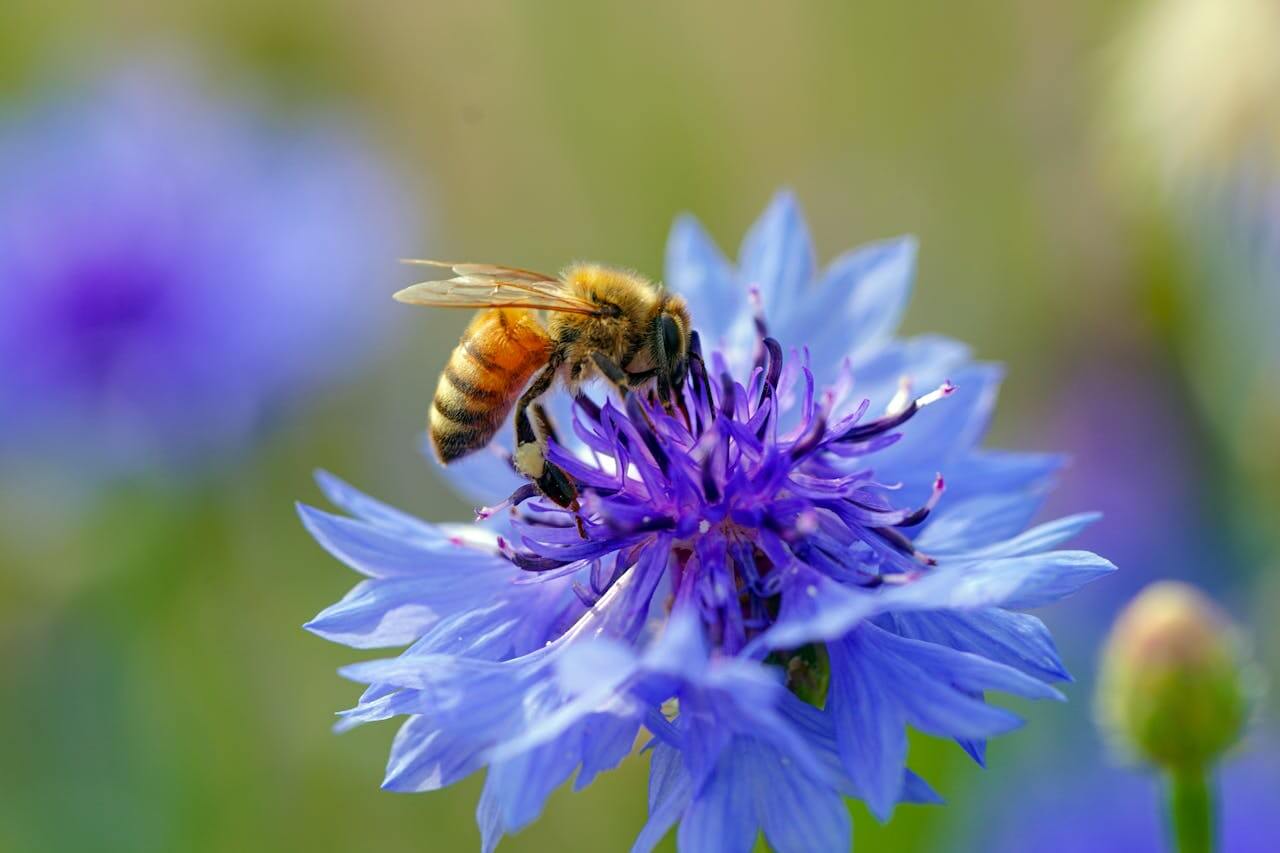
"Biene" is feminine in German — the correct article is die. The plural is die Bienen — simply add -n. In English, Biene means "bee".
Gender rule: There is no grammar rule that predicts the gender of Biene — it must be memorised together with its article. This is the same pattern as die Katze and die Maus. See all gender patterns in the Article Rules and a full overview at the German articles.
Die Biene is A1–A2 vocabulary and one of the most recognisable insect nouns in German — essential for nature topics and everyday conversation. It is a useful noun for practising feminine declension, where the article changes to der in both the genitive and dative singular. Understanding how cases affect feminine nouns like die Biene is an important step at A1–A2 level. Below you'll find the full declension table, example sentences, a common mistake to avoid, and a short quiz.
Biene — Declension Table
| Case | Singular | Plural |
|---|---|---|
| Nominative | die Biene | die Bienen |
| Genitive | der Biene | der Bienen |
| Dative | der Biene | den Bienen |
| Accusative | die Biene | die Bienen |
Example Sentences with Biene
Die Biene landet auf der gelben Blüte und sammelt Nektar.
(The bee lands on the yellow blossom and collects nectar.) — Nominative
Das Kind beobachtet die Biene aufmerksam durch das Küchenfenster.
(The child observes the bee attentively through the kitchen window.) — Accusative
Der Imker nähert sich der Biene ruhig und ohne hastige Bewegungen.
(The beekeeper approaches the bee calmly and without hasty movements.) — Dative
Der Stachel der Biene bleibt oft in der Haut stecken.
(The bee's stinger often stays stuck in the skin.) — Genitive
Die Bienen schwärmen im Frühling aus, um neue Nester zu gründen.
(The bees swarm out in spring to found new nests.) — Nominative Plural
Der Forscher entnimmt den Bienen regelmäßig Proben für seine Studie.
(The researcher regularly takes samples from the bees for his study.) — Dative Plural
Related Words & Compounds
Word family (Wortfamilie): The word family of Biene is very thin in modern German — no established adjectives or verbs share the same root. The noun stands largely on its own.
Compound adjectives: bienenfleißig (as busy as a bee — used colloquially to describe someone very hardworking)
Common compounds (Komposita): der Bienenstock (beehive), die Bienenkönigin (queen bee), der Bienenstich (bee sting — also the name of a popular German cake), das Bienenvolk (bee colony), die Bienenwabe (honeycomb)
Common Mistake with Biene
❌ Common mistake: Ich gebe dem Biene etwas Wasser.
✅ Correct: Ich gebe der Biene etwas Wasser.
💡 Why: In the dative singular, feminine nouns use the article der — not dem. Dem is the dative article for masculine and neuter nouns (e.g. dem Hund, dem Schaf). For feminine nouns, both the genitive and dative singular use der: der Biene. This is one of the most common errors with feminine nouns at A1–A2 level.
Quick Quiz: Test Your Knowledge
Can you get all three right? Apply what you've learned above.
1. Der Junge sieht ___ Biene auf seinem Arm.
- A) der Biene
- B) die Biene
- C) den Biene
Check Answer
"Sehen" (to see) takes a direct object in the accusative. For feminine nouns, the accusative article is die — the same form as the nominative. So both "Die Biene ist hier" (nominative) and "Er sieht die Biene" (accusative) use die. Option A) der is the genitive/dative article for feminine nouns — wrong case here. Option C) den is the accusative article for masculine nouns.
2. Der Stachel ___ Biene ist sehr dünn.
- A) die Biene
- B) dem Biene
- C) der Biene
Check Answer
The genitive expresses possession — whose stinger? The bee's. For feminine nouns, the genitive article is der and the noun itself does not change: der Biene. This is the standard rule for all feminine nouns — compare der Kuh, der Maus. Option B) dem is the dative for masculine/neuter nouns only.
3. Im Garten fliegt gerade eine sehr fleißig___ Biene.
- A) -er
- B) -e
- C) -es
Check Answer
After an indefinite article in the nominative with a feminine noun, the adjective ending is -e: eine fleißige Biene. The indefinite article eine already carries the feminine gender signal, so the adjective takes the weak ending -e. Compare: masculine ein fleißiger Vogel (-er), neuter ein fleißiges Pferd (-es).
Want to drill more nouns like this? The Article Trainer gives you 600+ nouns to practice — pick the article, get instant feedback, and stop guessing.
More Animal Nouns
- der Schmetterling — the butterfly
- der Vogel — the bird
- die Maus — the mouse
- das Kaninchen — the rabbit
- der Fuchs — the fox
- der Hai — the shark
- das Schaf — the sheep
- die Kuh — the cow
For more animal words, explore the full animal vocabulary list.
Is it der, die, or das Biene? Practice makes perfect.
The Article Trainer gives you 600+ nouns to drill — including animal vocabulary and much more. Pick the article, get instant feedback, and stop guessing.
Practice German Articles →Frequently Asked Questions
Is Biene masculine, feminine, or neuter in German?
Biene is feminine — the correct article is die. There is no grammar rule that predicts this gender, so die Biene must be memorised as a fixed combination. In the genitive and dative singular, the article changes to der — but the noun itself stays unchanged. See all gender patterns in the Article Rules.
What is the plural of Biene?
The plural is die Bienen — simply add -n to the singular form. Because the plural already ends in -n, the dative plural does not add another -n: den Bienen. This is the standard rule — dative plural only adds -n when the plural form does not already end in one.
What is the difference between Biene and Wespe in German?
Die Biene is a bee — it produces honey and plays a key role in pollination. Die Wespe is a wasp — it does not produce honey and is generally considered more aggressive. Both nouns are feminine in German. In everyday speech, learners sometimes confuse the two, but the distinction is clear: die Biene for bee, die Wespe for wasp.
Is Biene used in any German expressions?
Yes — the compound adjective bienenfleißig (literally "bee-industrious") is used colloquially to describe someone who works very hard and diligently, equivalent to "as busy as a bee" in English. It is a B1–B2 level expression and a good example of how Biene appears productively in the language despite having a thin word family.