
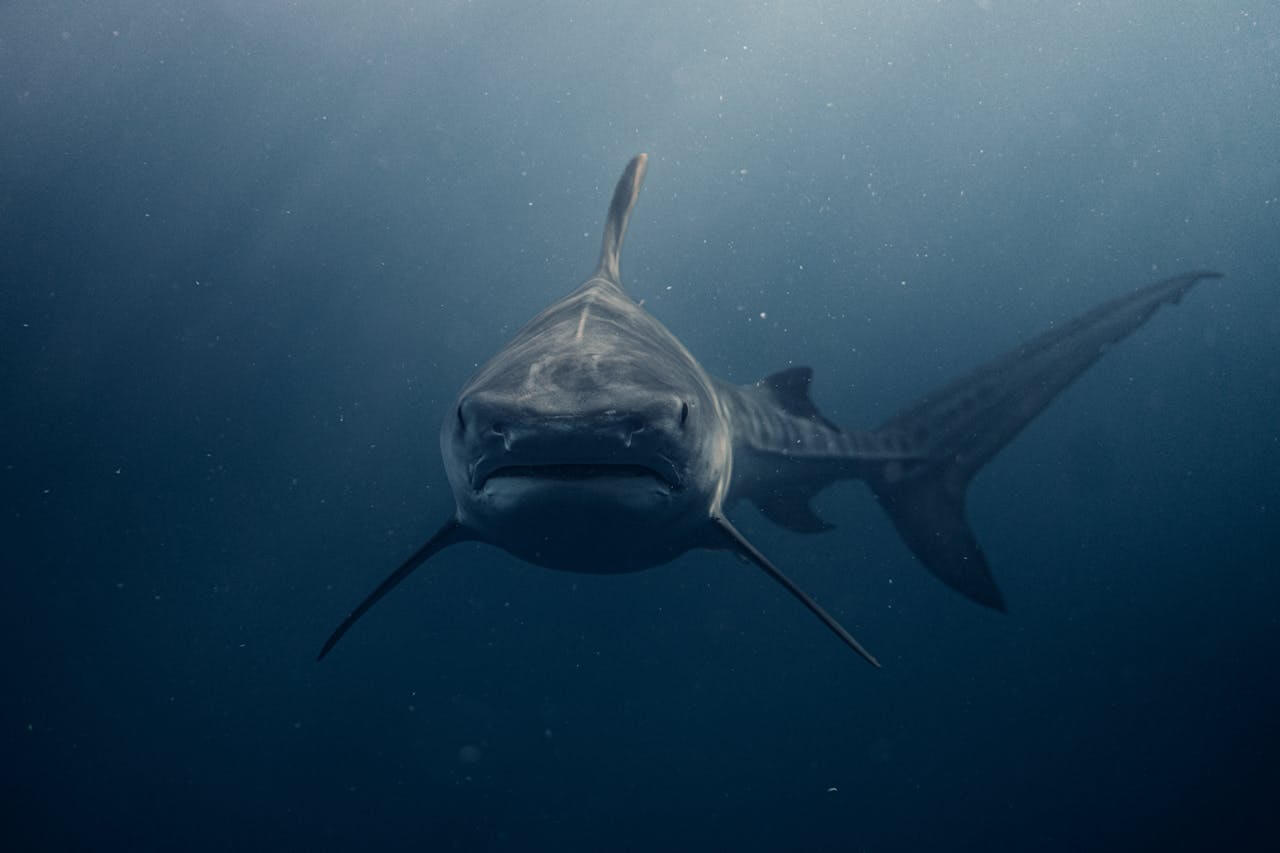
"Hai" is masculine in German — the correct article is der. The plural is die Haie — add -e, no Umlaut. In English, Hai means "shark". You will also encounter the compound form der Haifisch, which is used as a synonym.
Gender rule: The gender of animal nouns in German often has to be memorised individually. Der Hai is masculine — the same as der Wolf and der Tiger. The plural is die Haie — not die Hais. See all gender patterns in the Article Rules and a full overview at the German articles.
Der Hai is A2 vocabulary and one of the most recognisable sea animal nouns in German. It is a useful noun for practising masculine declension and the -e plural — a very common plural pattern in German. Understanding how cases work with masculine nouns like der Hai is an important step at A1–A2 level. Below you'll find the full declension table, example sentences, a common mistake to avoid, and a short quiz.
Hai — Declension Table
| Case | Singular | Plural |
|---|---|---|
| Nominative | der Hai | die Haie |
| Genitive | des Hais | der Haie |
| Dative | dem Hai | den Haien |
| Accusative | den Hai | die Haie |
Example Sentences with Hai
Der Hai schwimmt lautlos durch das tiefe, dunkle Wasser.
(The shark swims silently through the deep, dark water.) — Nominative
Die Taucherinnen beobachten den Hai aus sicherer Entfernung.
(The divers observe the shark from a safe distance.) — Accusative
Der Meeresbiologe nähert sich dem Hai vorsichtig mit dem Taucherboot.
(The marine biologist approaches the shark carefully in the dive boat.) — Dative
Die Flosse des Hais ragt deutlich aus dem Wasser heraus.
(The shark's fin protrudes clearly from the water.) — Genitive
Die Haie kreisen langsam um das gestrandete Boot.
(The sharks slowly circle the stranded boat.) — Nominative Plural
Die Forscher befestigen Sender an den Haien, um ihre Wanderrouten zu verfolgen.
(The researchers attach trackers to the sharks to follow their migration routes.) — Dative Plural
Related Words & Compounds
Word family (Wortfamilie): Hai is a loanword in German with uncertain etymology and has no established word family of its own. The noun stands on its own.
Common compounds (Komposita): der Haifisch (shark — compound synonym used in everyday speech), die Haifischflosse (shark fin), das Haifischbecken (shark tank / shark pool)
Common Mistake with Hai
❌ Common mistake: Im Ozean schwimmen viele Hais.
✅ Correct: Im Ozean schwimmen viele Haie.
💡 Why: The plural of der Hai is die Haie — add -e, not -s. The -s plural is rare in German and mostly limited to loanwords like das Auto → die Autos. Although Hai is itself a borrowed word, it has fully adopted a regular German plural pattern: die Haie. Compare the same plain -e plural in das Schaf → die Schafe.
Quick Quiz: Test Your Knowledge
Can you get all three right? Apply what you've learned above.
1. Die Taucherin sieht ___ Hai direkt unter sich.
- A) der Hai
- B) dem Hai
- C) den Hai
Check Answer
"Sehen" (to see) is a transitive verb — it takes a direct object in the accusative. The shark is what the diver sees, so it is the object. For masculine nouns, the accusative article is den: den Hai. Option A) der is nominative — the subject. Option B) dem is dative — used for indirect objects or after certain prepositions.
2. Welches ist der korrekte Plural von "der Hai"?
- A) die Hais
- B) die Haien
- C) die Haie
Check Answer
The plural of der Hai is die Haie — add -e. Option A) Hais uses the -s plural, which is rare in German and does not apply here. Option B) Haien is only correct in the dative plural: den Haien. In the nominative and accusative plural, the form is always die Haie.
3. Das ist ein sehr groß___ Hai.
- A) -e
- B) -es
- C) -er
Check Answer
After an indefinite article in the nominative with a masculine noun, the adjective ending is -er: ein großer Hai. Because ein doesn't carry the masculine gender signal, the adjective must show it. Compare: feminine eine große Maus (-e), neuter ein großes Schaf (-es).
Want to drill more nouns like this? The Article Trainer gives you 600+ nouns to practice — pick the article, get instant feedback, and stop guessing.
More Animal Nouns
- der Wolf — the wolf
- der Tiger — the tiger
- der Fuchs — the fox
- der Elefant — the elephant
- das Schaf — the sheep
- die Kuh — the cow
- der Bär — the bear
- der Löwe — the lion
For more animal words, explore the full animal vocabulary list.
Is it der, die, or das Hai? Practice makes perfect.
The Article Trainer gives you 600+ nouns to drill — including animal vocabulary and much more. Pick the article, get instant feedback, and stop guessing.
Practice German Articles →Frequently Asked Questions
Is Hai masculine, feminine, or neuter in German?
Hai is masculine — the correct article is der. There is no grammar rule that predicts this gender for animal nouns, so der Hai must be memorised as a fixed combination. In the genitive singular, the noun adds -s: des Hais. See all gender patterns in the Article Rules.
What is the plural of Hai?
The plural is die Haie — add -e, with no Umlaut. Do not use Hais — the -s plural does not apply here. In the dative plural, a further -n is added: den Haien.
What is the difference between Hai and Haifisch?
Der Hai and der Haifisch are synonyms — both mean "shark" in German. Haifisch is a compound of Hai and Fisch (fish), so it is literally "shark-fish". Both forms are used in everyday German, and both are masculine. Haifisch appears frequently in compounds such as die Haifischflosse (shark fin) and das Haifischbecken (shark tank).
Is Hai used in any German expressions?
Yes — der Kredithai (loan shark) is a well-established German term for a predatory lender. It combines Kredit (credit / loan) with Hai (shark), using the same figurative logic as the English expression. This is a useful B1–B2 vocabulary item for learners interested in financial language.